
Water marigold
Megalodonta beckii
Description
Growing requirements
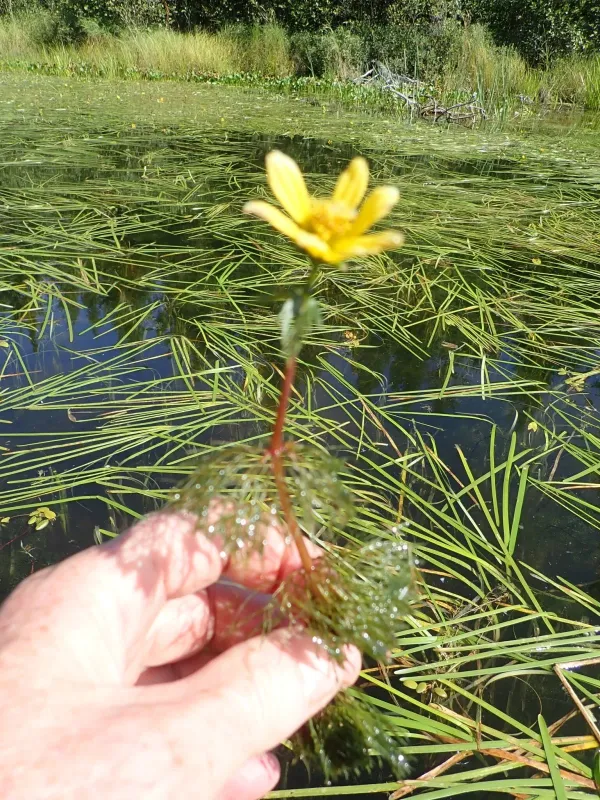
Water marigold, scientifically known as Megalodonta beckii, is a perennial aquatic plant belonging to the Asteraceae family. Although it bears yellow flowers similar to those of the Bidens genus, its unique underwater leaf structure distinguishes it as a specialized hydrophyte.
The native range of this plant is concentrated in North America, particularly in the northern United States and southern Canada. It thrives in various freshwater habitats, including lakes, ponds, and slow-moving streams, where it anchors itself into the substrate.
The plant exhibits heterophylly, a fascinating evolutionary adaptation. The submersed leaves are finely divided and thread-like, facilitating efficient nutrient uptake, whereas the emergent leaves are simple and serrated, designed to function effectively in an atmospheric environment.
Regarding environmental requirements, Megalodonta beckii needs clear, undisturbed water with moderate nutrient levels. It is quite sensitive to habitat degradation and serves as a valuable indicator species for the health of aquatic ecosystems in its native range.
While not a major commercial crop, it is of significant interest for ecological restoration and aquatic horticulture. Proper cultivation requires attention to water chemistry and light penetration, ensuring that the plant receives adequate conditions to maintain its biological cycle.