
Medusagyne oppositifolia
Medusagyne oppositifolia
Description
Growing requirements
Medusagyne oppositifolia, commonly known as the jellyfish tree, is a critically endangered species native exclusively to the island of Mahé in the Seychelles. It is the sole member of the Medusagynaceae family and represents a unique botanical lineage that has evolved in isolation.
The plant thrives in rugged, rocky terrain at higher altitudes, where the climate is characterized by high humidity and consistent precipitation. It is not an agricultural crop, and there is no record of its use in commercial farming, forestry, or horticultural production.
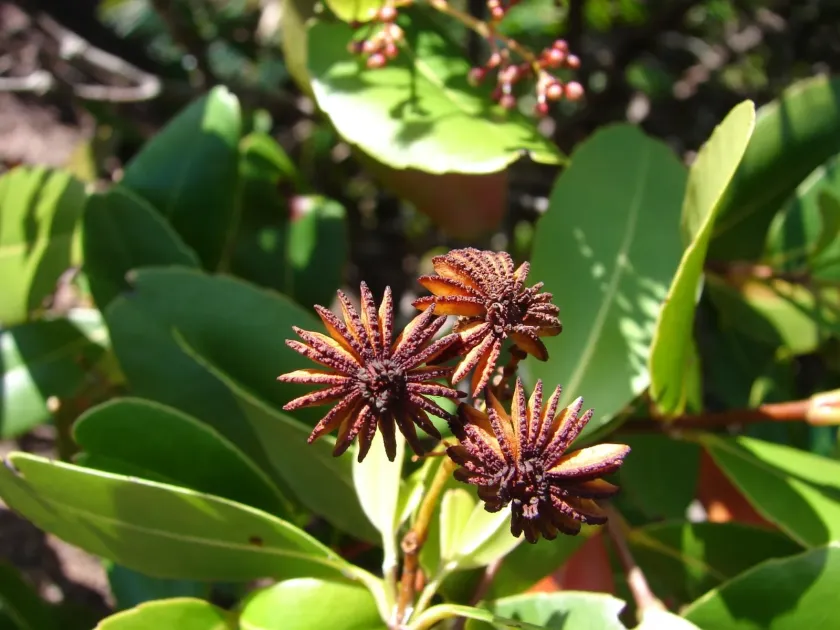
Botanically, it is defined by its opposite, leathery leaves and distinctive fruit capsules. These capsules split into segments that resemble the shape of a jellyfish, which serves as the morphological basis for its common and scientific names.
Its ecological requirements include highly specific mineral soil conditions and protection from human interference. The plant relies on stable tropical conditions, and its slow growth rate makes it entirely unsuited for any form of agricultural exploitation or plantation management.
Given its status as one of the rarest trees on Earth, conservation efforts are focused on habitat protection rather than cultivation. Any attempt to harvest or propagate the species outside of controlled botanical research is strictly prohibited by international and local regulations.