
Leucosphaera bainesii
Leucosphaera bainesii
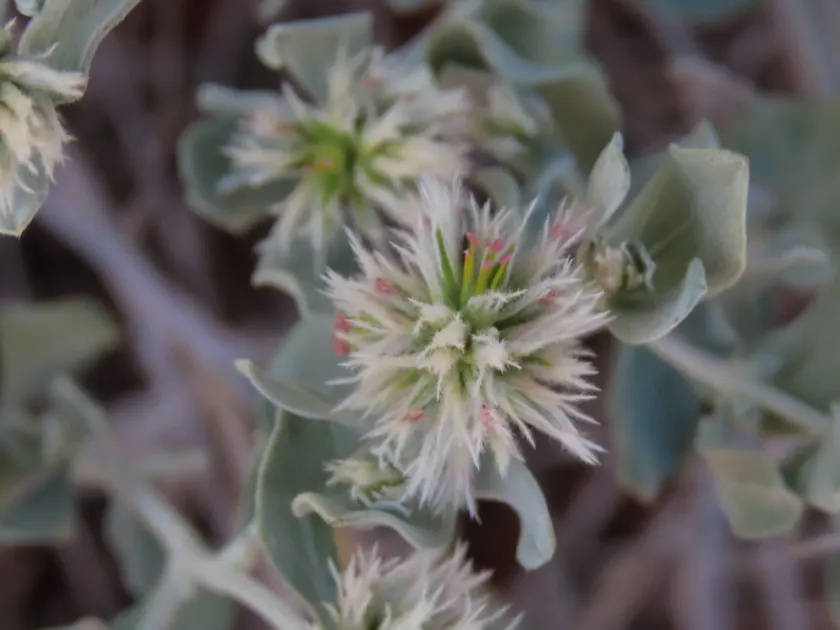
Description
Growing requirements
Leucosphaera bainesii is a perennial herbaceous subshrub belonging to the Amaranthaceae family. It is a highly specialized plant species that has evolved to thrive in the harsh, arid environments of Southern Africa.
The plant originates from the dry regions of Botswana, Namibia, and South Africa, specifically within the Kalahari Desert ecosystem. It is exceptionally well-adapted to extreme thermal fluctuations and prolonged periods of water scarcity.
Botanically, Leucosphaera bainesii is characterized by silvery-grey trichomes (hairs) covering its stems and leaves. This feature provides a significant evolutionary advantage by reflecting intense solar radiation and reducing the rate of water loss through transpiration.
Regarding soil requirements, the species flourishes in sandy and sandy-loam soils with low fertility, typical of desert landscapes. It exhibits remarkable salt tolerance, allowing it to grow in soil conditions that would be toxic to most conventional agricultural crops.
Optimal growth is achieved in well-drained locations with full sun exposure. The plant requires excellent aeration in the root zone and is highly sensitive to waterlogging, which can lead to rapid root decay if drainage is inadequate.
Yield
The primary economic and agricultural value of Leucosphaera bainesii lies in its utility as a reliable forage source for livestock, particularly in regions prone to frequent droughts where traditional pastures fail.
The plant maintains nutritional viability during extreme dry seasons, providing essential minerals and roughage for cattle and small ruminants. Its ability to remain green when other vegetation has desiccated makes it a vital resource for pastoral stability.
Yields of vegetative mass are directly correlated with seasonal precipitation patterns, yet the plant remains consistent in its biomass production under conditions that would inhibit most other cultivated forage species.
Beyond its feed value, the species serves as an effective soil stabilizer. Its deep and expansive root architecture makes it an excellent choice for combating wind erosion and reclaiming desertified land areas.
Seeds are increasingly utilized in environmental restoration projects to rehabilitate degraded landscapes and industrial sites, facilitating the re-establishment of native flora in arid zones.
Main diseases and pests
While Leucosphaera bainesii is inherently resilient, it can be susceptible to localized insect pests, particularly grasshoppers, which may impact young growth during the active growing season following rainfall.
Fungal infections are generally rare in the arid natural habitats of the plant but may occur in cultivation if moisture levels are kept abnormally high or if ventilation is insufficient within the crop canopy.
Overgrazing poses the most significant threat to the long-term productivity of the species. Intensive grazing pressure prevents the plant from setting seed and weakens the root system, ultimately leading to stand thinning.
Competition from aggressive weeds during the early establishment phase can hinder the development of young plants. Careful management of field conditions during the initial sowing stages is essential for success.
To ensure sustainable yields, rotational grazing management is recommended to allow the plant to recover and maintain its vigor throughout its perennial lifecycle.