
California honeysuckle
Justicia californica
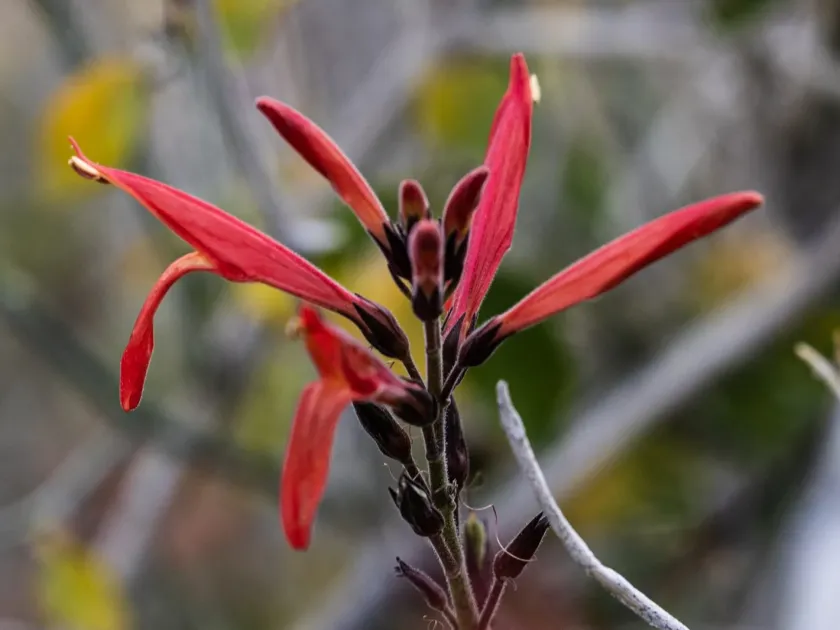
Description
Growing requirements
California honeysuckle (Justicia californica) is a distinctive member of the Acanthaceae family, native to the arid environments of the Southwestern United States and Mexico. It is widely recognized for its adaptation to desert landscapes.
The plant thrives in full sun exposure. High light intensity is essential for the bush to maintain its characteristic structure and produce the vibrant, tube-shaped flowers that attract local hummingbirds.
Soil requirements focus primarily on drainage. The species cannot tolerate waterlogged soils, making sandy, well-draining, or rocky substrates the ideal medium for successful cultivation in both natural and managed settings.
Climatic adaptability is a hallmark of this species. It handles high desert heat effortlessly and remains one of the most reliable options for gardeners in regions experiencing extreme summer temperatures and minimal rainfall.
Morphologically, the shrub features slender, gray-green stems and sparse foliage. This design allows the plant to reduce water transpiration, effectively surviving long drought cycles by entering a dormant phase if necessary.
Harvesting
The primary horticultural application of California honeysuckle is in the field of xeriscaping, where water conservation is a priority in landscape architecture.
It serves as a functional plant for erosion control on dry hillsides and arid slopes, where its root system helps stabilize loose, poor-quality soil.
The plant is highly valued for ecological restoration projects, as it provides a critical food source for pollinators in desert ecosystems that are otherwise scarce in nectar-bearing plants.
Harvesting for propagation involves collecting mature seed pods at the end of the flowering season, ensuring they are dry enough for extraction before storage.
Pruning is primarily performative, used to manage the bush's spread and improve its aesthetic presence within a landscape design, ensuring it does not become too leggy or overgrown.