
Hladnikia pastinacifolia
Hladnikia pastinacifolia
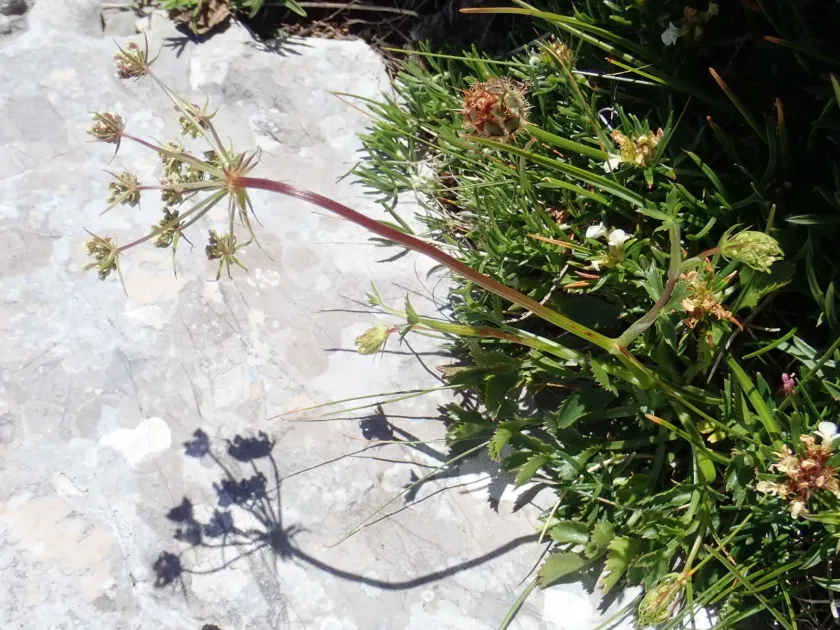
Description
Growing requirements
Hladnikia pastinacifolia is a perennial herbaceous plant belonging to the Apiaceae (or Umbelliferae) family. This species is a rare endemic, restricted primarily to the limestone plateaus of the Trnovski Gozd region in Slovenia, where it thrives in specific microclimates.
The plant prefers cool, humid mountain environments. It is naturally adapted to high-altitude areas with significant atmospheric moisture, making it sensitive to extreme heat and dry conditions often found in lowland agricultural settings during summer months.
Cultivation requires well-drained, limestone-rich soils. Given its natural habitat in rocky crevices and scree slopes, drainage is the most critical factor for success. Waterlogging must be strictly avoided, as the root system is highly susceptible to decay in heavy, compacted soils.
Botanically, the species is identified by its rosette of pinnately divided leaves that closely resemble those of the common parsnip. The plant produces umbellate inflorescences typical of the family, and its structure is adapted to withstand strong alpine winds and varying light conditions.
While not a traditional commercial crop, Hladnikia pastinacifolia is significant for conservation biology and botanical research. Its unique chemical profile, typical of high-altitude Apiaceae, makes it a subject of interest for phytochemical analysis and potential future pharmacological applications.