
Sturt's Desert Rose
Gossypium sturtianum
Description
Growing requirements
Sturt's Desert Rose (Gossypium sturtianum) is a perennial shrub classified within the Malvaceae family. Native to Australia, it is well-adapted to the harsh environments of the continent's arid interior.
The plant thrives in rocky or sandy soils that possess excellent drainage properties. It is naturally resistant to high solar radiation and severe water deficits, making it a model for drought-tolerant research in agricultural science.
Cultivation requirements include a sunny position with very low humidity levels. The root system is extremely sensitive to waterlogging, necessitating precise irrigation schedules in any managed environment.
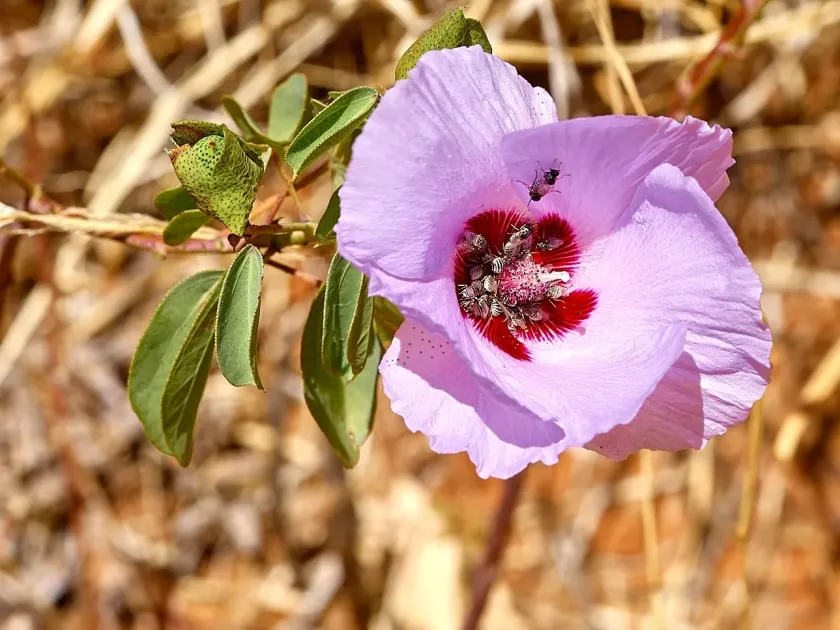
Morphologically, the shrub reaches heights of up to two meters, featuring grey-green leaves and distinctive purple flowers with a deep red center. These aesthetic traits have made it popular in xeriscaping and botanical collections.
While Gossypium sturtianum produces a cotton-like fiber, it is not economically viable for industrial spinning due to its short staple length. Its primary value in agriculture remains its genetic potential for breeding resilience into commercial cotton varieties.
Main diseases and pests
The primary threat to the longevity of Gossypium sturtianum is the development of fungal pathogens, particularly Phytophthora, caused by excessive moisture in the root zone.
Insect pests such as aphids and whiteflies can be problematic if the plant is grown in sheltered or humid environments, leading to leaf distortion and reduced vigor.
Root-knot nematodes pose a risk in areas with previous susceptible crop history, requiring careful site selection and soil sterilization if the crop is grown in intensive systems.
Management practices should prioritize air circulation and the avoidance of overhead irrigation, which limits the spread of foliar diseases during cooler periods.
Monitoring for localized infections is crucial, as the plant's slow growth habit makes recovery from significant pest or disease outbreaks particularly challenging.