
Gossypium incanum
Gossypium incanum
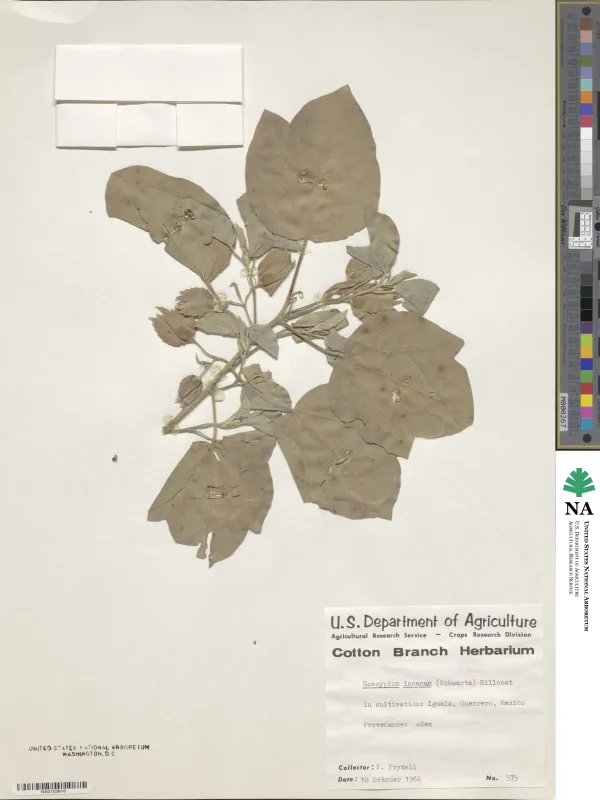
Description
Sowing dates
Gossypium incanum, commonly known as grey cotton, is a species in the Malvaceae family. It is a perennial shrubby plant that is often managed as an annual crop in agricultural systems to optimize yield and simplify harvesting.
Sowing occurs when soil temperatures consistently reach at least 15 degrees Celsius. This ensures rapid and uniform germination, which is critical for a successful growing season.
Seeds are sown at a depth of 3-5 cm. The planting pattern usually involves rows spaced 70 to 90 cm apart to allow for proper plant spacing and airflow through the canopy.
Seedbed preparation is vital to reduce weed competition early on. Precision seeding technology helps in establishing an optimal population density per hectare.
The timing of sowing must balance the need for warmth with the availability of soil moisture. Early planting helps the crop establish a deep root system before the onset of extreme summer heat.
Growing requirements
This crop thrives in hot, sunny climates. It is highly adapted to arid environments but requires consistent moisture availability during the critical flowering and boll development stages.
Soil requirements include well-drained, fertile substrates. Sandy loam or silty loam soils with a neutral pH level are considered ideal for achieving maximum fiber quality.
Nutrient management is essential, with a particular focus on phosphorus and potassium levels in the soil to support robust boll development and strong fiber structure.
Excessive humidity or waterlogging must be avoided, as the root system of Gossypium incanum is susceptible to rot in anaerobic soil conditions.
The plants are quite sensitive to frost and cold snaps; therefore, the selection of the region and site is determined by the length of the frost-free season.
Yield
The yield of Gossypium incanum is largely dependent on the number of bolls per plant and the weight of the lint per boll. High yields require intensive management during the irrigation and fertilization phases.
Techniques such as topping, where the terminal bud is removed, are often employed to redirect plant energy toward boll development rather than vegetative growth.
Good agricultural practices, including effective weed and pest control, can significantly increase the final harvest weight per hectare.
Post-harvest processing involves careful handling to maintain fiber length and purity. Quality grading is essential for determining the market value of the output.
Average yield figures depend on local conditions and input levels, but successful farms utilize modern varieties to maximize output and fiber consistency.
Main diseases and pests
Pest management is the most significant challenge in cotton farming. The bollworm complex can cause devastating damage to the crop by feeding on reproductive structures.
Fungal diseases like Verticillium wilt remain a constant threat. These pathogens obstruct the plant's vascular system, leading to wilted leaves and severely reduced yields.
Integrated Pest Management (IPM) strategies, including the use of pheromone traps and biological controls, are highly recommended to minimize chemical reliance.
Effective crop rotation with legumes or cereals helps break the life cycles of soil-borne diseases and improves overall soil health for subsequent seasons.
Early detection of infestations or disease symptoms is crucial. Regular scouting programs enable farmers to target affected areas before the problem spreads across the field.
Harvesting
Harvesting typically takes place once the bolls have naturally matured and dehisced (opened). Timing must be managed carefully to avoid weather damage to the exposed fiber.
Defoliation is often performed prior to harvest to remove leaves, which prevents leaf trash from contaminating the cotton lint during mechanical picking.
Mechanical harvesting via cotton pickers is the standard method for large-scale production, ensuring efficiency and speed during the critical harvest window.
After picking, the cotton must be stored in dry conditions to prevent mold growth or discoloration of the fiber, which would decrease its commercial value.
Cleaning and ginning processes follow the harvest, where seeds are separated from the fiber to prepare the product for textile manufacturing.