
Sand bedstraw
Galium arenarium
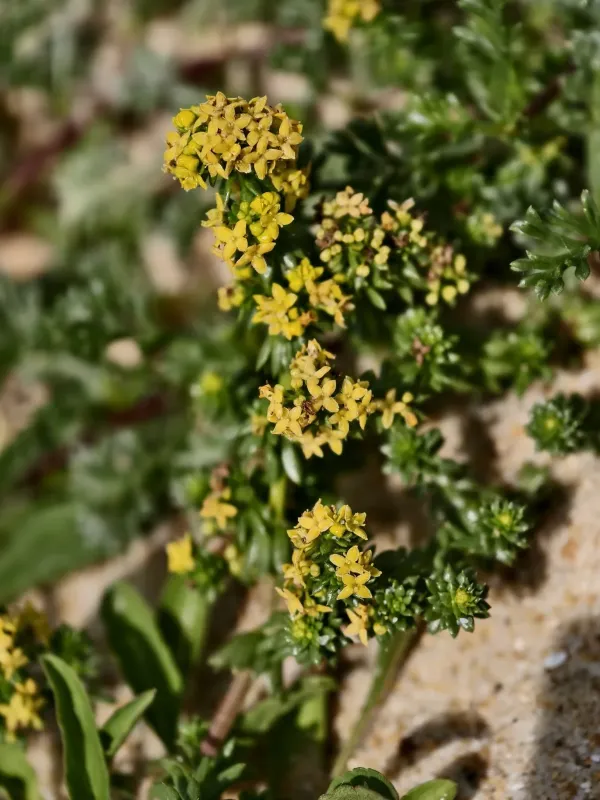
Description
Sowing dates
Sowing of sand bedstraw is carried out mainly in early spring when the soil warms up to 8–10 degrees Celsius. To obtain uniform germination, the seeds require cold stratification in the ground, so autumn sowing is also an effective practice in regions with a temperate climate.
The sowing depth should not exceed 1–2 centimeters, as small seeds have a limited energy reserve for germination through dense soil layers. An optimal sowing pattern involves row spacing of 30–45 centimeters, which facilitates subsequent crop care.
The soil before sowing must be thoroughly leveled and cleared of weeds, as the crop is sensitive to competition during the initial stages of development. The use of light substrates allows the plant to develop its root system, characteristic of sandy-soil species, more quickly.
Seedlings appear 15–20 days after sowing, provided there is sufficient moisture in the top layer of the soil. In the case of a lack of rainfall in the first weeks, the crops require gentle irrigation to prevent the young roots from drying out.
The intensity of crop growth increases by the beginning of summer when the plant begins to form vegetative mass. Choosing the right sowing date allows the crop to strengthen before the onset of critical summer temperatures and dry periods.
Growing requirements
Sand bedstraw is a member of the Rubiaceae family and prefers well-drained, sandy, or loamy soils. The plant reacts extremely negatively to waterlogging, making the choice of a field with a low groundwater level an essential condition for success.
The crop has moderate light requirements and develops perfectly in open, sunny locations. Under partial shading conditions, the plant may become spindly, which negatively affects the quality of the raw material and the content of biologically active substances.
Soil acidity for optimal growth should be in the range of pH 6.0–7.5. In overly acidic soils, the plant's development slows down, which requires liming the area in advance, several months before sowing seeds.
The plant has high drought resistance due to the specific structure of its root system. Nevertheless, to obtain a high yield of green mass, it is necessary to maintain a moderate level of moisture during the critical phases of vegetation.
Agricultural management requires timely loosening of the rows to ensure oxygen access to the roots. This contributes to the activation of soil microflora and better absorption of nutrients from sandy soils, which are usually poor in organic matter.
Main diseases and pests
The main threats to the crop are fungal diseases that develop in conditions of high air humidity. Powdery mildew can affect leaves during periods of frequent fog and prolonged rain, reducing the overall photosynthetic activity of the plant.
Root rots pose a danger if the wrong site with heavy clay soil is selected. The infection blocks the vascular system of the plant, which leads to rapid wilting and the death of the entire crop, so drainage prevention is crucial.
Among pests, leaf-eating insects and aphids, which feed on young shoots during the active growth phase, pose the greatest danger. Regular monitoring of crop condition allows for timely detection of signs of infestation and intervention.
Weeds are a serious competitor for bedstraw in its first year of life. Perennial rhizomatous weeds are especially dangerous, as they are capable of completely suppressing the development of the young crop, so field hygiene is a key protection factor.
To combat threats, it is recommended to use an integrated approach combining proper crop rotation and biological control methods. The use of chemicals should be strictly limited if the herb is intended for medicinal use.
Harvesting
Harvesting of sand bedstraw is carried out during the period of mass flowering, when the concentration of useful substances in the aerial part reaches its peak. Depending on the climatic zone, this usually occurs in the middle or end of the summer season.
Mowing is performed at a height of 5–10 centimeters from the ground level, trying not to damage the root crown. The use of specialized harvesters or manual scythes allows for quick collection and prompt transport for drying.
Harvested material must be quickly delivered to the processing site, as fermentation starting in piles can lead to a loss of marketability and quality. Spreading in a thin layer ensures uniform moisture removal from the stems.
Drying is carried out in the shade or in special dryers at a temperature not exceeding 45 degrees Celsius. Overheating the raw material leads to the destruction of essential oils and glycosides, which constitute the main value of this plant for the industry.
After drying, the mass is brought to standard moisture content, packed, and sent for storage in cool, dry rooms. Proper organization of harvesting and post-harvest processing allows the product to be preserved for a long time.