
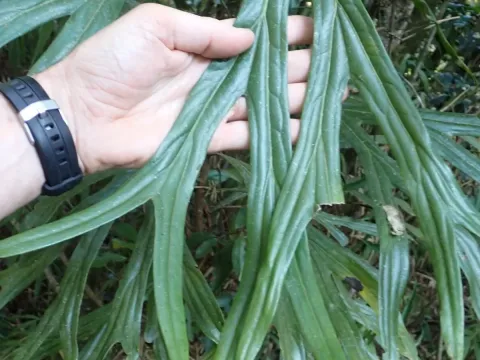
Dilobeia
Dilobeia Thouars
Dilobeia (Dilobeia thouarsii) is a genus of evergreen trees endemic to Madagascar, belonging to the Proteaceae family. In their natural habitat, they reproduce through seeds, though cultivation of this species is extremely limited in professional horticulture.
What the section contains

Dilobeia
For research and botanical collection purposes, seeds must be planted immediately after harvest due to their short viability period. Optimal germination requires a temperature range between 24–28°C paired with consistently high moisture.
The substrate for propagation should be acidic, well-draining, and rich in organic matter. Dilobeia seedlings are highly susceptible to root rot, which makes efficient drainage a critical requirement for successful cultivation.
Cultivation practices involve maintaining a consistent light regime, as the plant is sensitive to sudden changes in irradiance. The growth rate is notably slow, necessitating a long period of nursery care before the plants reach a size suitable for planting.
Large-scale commercial production does not currently exist for Dilobeia. Conservation efforts are prioritized over agricultural exploitation due to the species' status within the fragile ecosystems of Madagascar.
This crop requires a tropical, humid climate to thrive, consistent with the conditions found in Madagascar's forest regions. The species is adapted to areas where annual rainfall remains high throughout the year.
Soil requirements involve well-drained, nutrient-poor conditions typical of tropical forests. Dilobeia is generally adapted to understory environments, preferring semi-shaded conditions rather than intense direct sunlight.
The plant is highly intolerant of frost and prolonged periods of drought. Temperatures dropping below 15°C can cause severe metabolic stress and damage to the foliage, halting growth indefinitely.
Maintaining a stable, slightly acidic soil pH is essential for the healthy function of the plant's metabolic processes. Excess lime in the soil frequently induces chlorosis and stunts development.
Dilobeia often relies on specific mycorrhizal associations for nutrient uptake, which are typical for Proteaceae members. The lack of these beneficial soil fungi in artificial settings is a primary challenge for growers.
The economic use of Dilobeia is primarily linked to its timber, which is appreciated for its high density and unique grain. Historically, local populations used it for specialized carpentry and traditional crafts.
Due to its slow growth and endemic nature, the species does not provide commercial yields. It is not currently utilized as an agricultural crop, and research remains focused on ecological and taxonomic studies.
The fruits do not have industrial food value. The focus of Dilobeia utilization is centered on preserving biodiversity rather than extracting marketable agricultural products or biomass.
Current research into the plant's chemical composition for potential pharmaceutical use is in the early stages. There are no cultivars currently available that are optimized for high-productivity commercial farming.
Timber harvesting is strictly limited due to the conservation status of the species. Sustainable management of remaining wild populations is the priority over any form of industrial harvesting.
The primary threat to Dilobeia is habitat destruction, particularly due to deforestation and land-use changes on Madagascar. This has placed the species in a vulnerable position within its native range.
In greenhouse conditions, the plant is susceptible to common pests such as mealybugs and spider mites. These pests proliferate rapidly if the ambient humidity is not managed correctly.
Fungal root diseases represent the most critical threat during early stages of cultivation. Waterlogged conditions rapidly promote root decay, which is often irreversible for this specific plant type.
Leaf spot diseases, caused by various pathogens, can occur in poorly ventilated environments. Regular monitoring and the removal of affected foliage are necessary to maintain healthy specimens.
Pest management should focus on biological control agents. The use of harsh chemical pesticides is generally discouraged, as the delicate foliage of Dilobeia can easily suffer from phytotoxicity.