
Desmodesmus subspicatus
Desmodesmus subspicatus
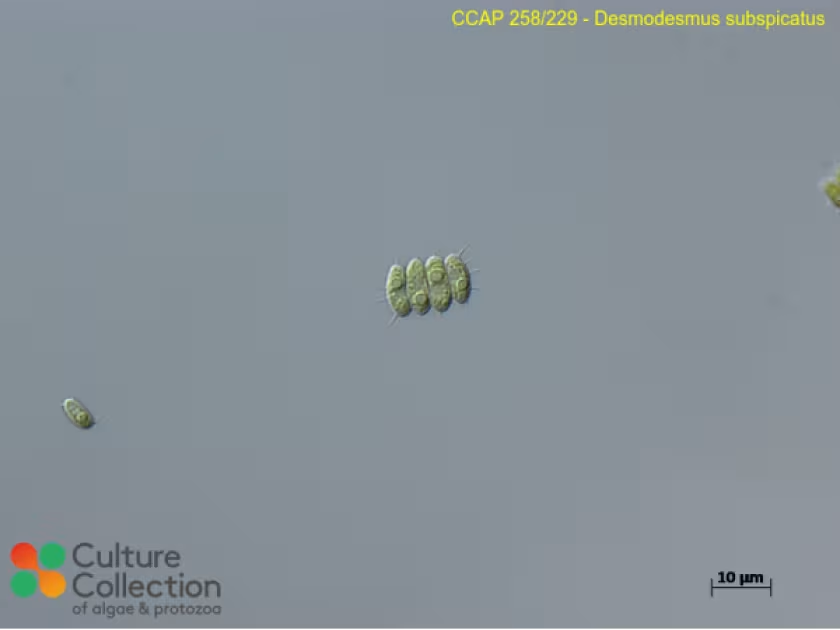
Description
Growing requirements
Desmodesmus subspicatus is a unicellular green microalga belonging to the Scenedesmaceae family. It is widely recognized in scientific research and industrial biotechnology as a robust and adaptable organism.
Optimal cultivation requires an environment with controlled temperature, typically between 20°C and 30°C. Maintaining these conditions ensures consistent metabolic rates and prevents cellular stress.
The culture demands specific nutritional input, primarily nitrogen, phosphorus, and trace minerals. These nutrients are essential for the production of proteins and lipids, which are the main targets for commercial exploitation.
Light intensity plays a crucial role in photosynthesis. High light saturation is beneficial for biomass accumulation, but it must be managed carefully to avoid photo-inhibition or bleaching of the cells.
Carbon dioxide supplementation is necessary for high-density cultivation. Injecting CO2 into the culture medium significantly enhances the photosynthetic efficiency and shortens the doubling time of the cells.
Yield
The productivity of Desmodesmus subspicatus is largely determined by the culture system employed. Closed photobioreactors generally provide higher yields compared to open-pond systems.
Under optimized growth conditions, the biomass contains a balanced ratio of lipids and carbohydrates, making it a viable candidate for both food additives and biofuel production.
The harvest efficiency is highly dependent on the method of cell separation. Techniques like flocculation or centrifugation are typically used to recover the biomass from the cultivation medium.
Researchers are continuously working on optimizing the nutrient supply to trigger specific metabolic pathways, such as the synthesis of omega-3 fatty acids or high-quality amino acids.
Large-scale production systems often utilize automated monitoring to maintain nutrient levels and pH, ensuring consistent output and minimizing the risk of culture collapse.
Main diseases and pests
Grazing by protozoans and rotifers is a major challenge in large-scale cultivation. These organisms can consume the algal population rapidly, leading to significant economic losses.
Contamination by invasive species of other algae or fungi can compromise the monoculture, leading to reduced productivity and difficulties in downstream processing of the biomass.
Viral pathogens that specifically target the cell walls of Desmodesmus can cause mass lysis. Implementing strict biosecurity protocols is essential to prevent such outbreaks.
Environmental fluctuations, such as unexpected shifts in temperature or pH, can destabilize the metabolic processes of the algae, resulting in cell cycle arrest or senescence.
- Strict sterilization of all media components.
- Use of dedicated closed-loop systems.
- Regular microscopic examination for contaminants.
- Implementation of quarantine zones for inoculum production.