
Western houndstongue
Cynoglossum occidentale
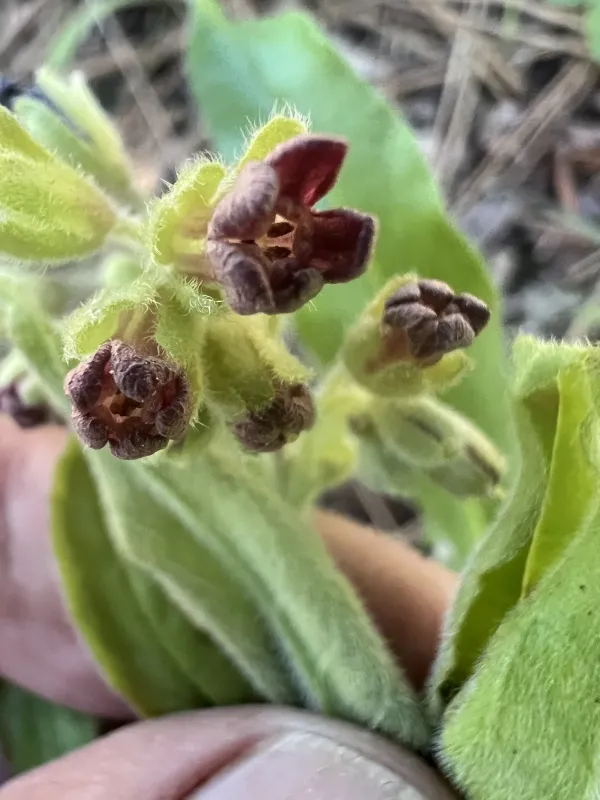
Description
Sowing dates
Cynoglossum occidentale, belonging to the Boraginaceae family, is typically propagated via seeds. Fall sowing is the most effective method, as it facilitates natural stratification during the winter season.
Seeds should be planted at a depth of 1.5 to 2 centimeters. Ensuring proper soil-to-seed contact is essential for uniform germination in early spring.
If sowing in the spring, seeds must be artificially stratified in a cold environment for at least 4-6 weeks to achieve a satisfactory emergence rate.
Row spacing should be maintained at 40-50 centimeters to allow for mechanical weeding and to promote good air circulation around the developing rosettes.
Emergence typically occurs within three weeks once soil temperatures reach 10-15 degrees Celsius, provided moisture levels are consistently adequate.
Growing requirements
The crop performs best in well-drained, sandy loam soils. It is notably sensitive to waterlogged conditions, which can lead to rapid crown and root rot.
Being a drought-tolerant species native to western North American regions, it adapts well to areas with limited annual precipitation and high solar radiation.
Exposure to full sunlight is required for optimal physiological function. Shaded conditions lead to stunted growth and reduced metabolic efficiency.
Soil pH should ideally be neutral or slightly alkaline. The plant does not require high levels of nitrogen and is well-suited for lower-fertility sites.
Maintenance involves minimal irrigation after the establishment phase, as the plant possesses a deep taproot that accesses subsoil moisture.
Main diseases and pests
Fungal pathogens such as powdery mildew and root rot represent the primary threats to crop health, especially during periods of high humidity.
Pest management focuses primarily on aphids, which can vector viruses and weaken young seedlings during the initial vegetative development phase.
Weed management is critical, particularly during the first year, as the slow growth rate of the rosettes makes them vulnerable to competition from aggressive grasses.
Maintaining a clean field and utilizing proper row spacing are the most effective non-chemical strategies for mitigating disease and pest outbreaks.
- Monitor for signs of chlorosis.
- Remove infected plant debris.
- Use integrated pest management (IPM).