
Coleanthus subtilis
Coleanthus subtilis
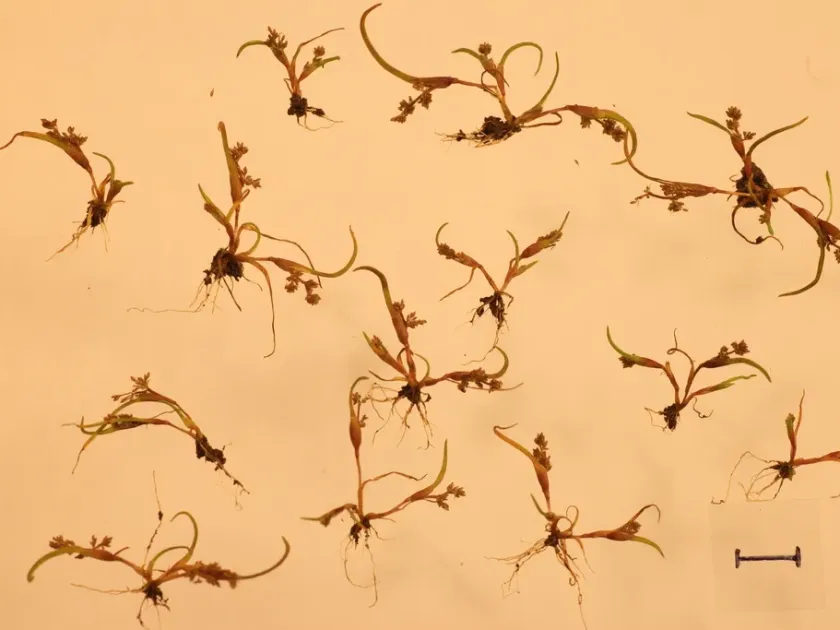
Description
Growing requirements
Coleanthus subtilis, commonly known as the mossy sandwort or more accurately the delicate Coleanthus, is a rare annual grass belonging to the Poaceae family. It is not an agricultural crop but a botanically significant plant recognized globally for its rarity.
The distribution of Coleanthus subtilis is highly disjointed across the Northern Hemisphere. It is typically found in specific microhabitats, primarily on muddy or sandy banks of ponds, lakes, or slow-moving rivers that experience periodic water level fluctuations.
The morphology of the plant is defined by its small stature and hidden inflorescences. The spikelets are situated within the leaf sheaths, which is the defining characteristic that separates it from other members of the Poaceae family.
Ecologically, the plant requires open, moist, and nutrient-rich substrates with very little competition from other vegetation. It acts as a pioneer species on newly exposed mudflats, thriving where other plants cannot yet establish themselves.
There are no farming techniques, sowing methods, or harvest cycles for Coleanthus subtilis, as it is a protected species in most regions. Any attempts to treat it as an agricultural commodity would contradict conservation efforts for this endangered grass.
Main diseases and pests
The primary threats to Coleanthus subtilis involve the alteration of wetland habitats. Projects such as dam construction or canalization that stabilize water levels prevent the formation of the necessary mudflat habitats required for the species to germinate.
As this species is not cultivated for agricultural purposes, there is no documented data regarding typical crop diseases or pests. The plant remains a focus of conservation ecology rather than agronomy, existing in limited numbers within sensitive ecosystems.