
Blue mustard
Chorispora tenella (Pall.) DC.
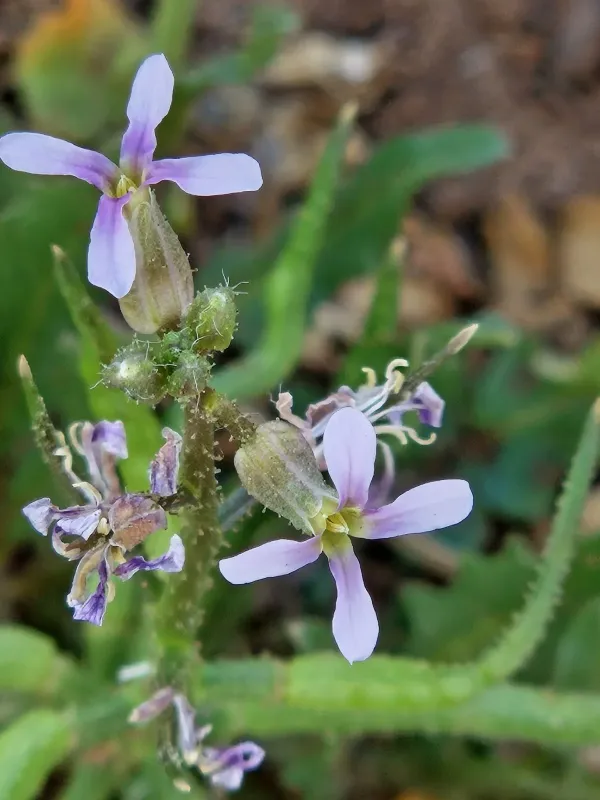
Description
Sowing dates
Blue mustard is an annual weed that typically germinates in early spring. Its seeds can germinate at very low temperatures, often immediately after the snow melts, giving it a significant competitive advantage over spring crops.
Winter-annual populations germinate in late summer or autumn, forming rosettes that successfully overwinter. These plants resume growth very early in the following spring, often reaching the flowering stage before most crops are fully established.
The lifecycle from germination to seed production is remarkably rapid. This allows the plant to complete its reproductive phase before the main crop reaches its canopy-closure stage, causing major resource competition.
Seed bank longevity is a key challenge, as seeds can remain viable in the soil for several years. This persistent nature necessitates a multi-year strategy to reduce the weed population density in agricultural fields.
Temperature fluctuations in early spring do not hinder its development. Instead, the plant exploits these conditions to grow faster than the surrounding crop species, often becoming the dominant vegetation in early spring.
Growing requirements
Chorispora tenella is highly adaptable to various soil types, including sandy, loamy, and even somewhat saline soils. It does not require high levels of nutrients to thrive, making it a persistent weed in low-input farming systems.
The plant thrives in open, sunny environments. In dense, healthy crop stands, the competition for light effectively suppresses the growth of Blue mustard, making good agronomic practices the first line of defense.
Moisture availability during the early vegetative phase is essential for rapid growth. However, once established, the plant demonstrates good drought tolerance due to its taproot system.
Soil pH variations have limited impact on the distribution of this species. It is frequently observed along roadsides, in neglected fields, and within winter cereal crops across vast arid and semi-arid regions.
Agrotechnical methods such as crop rotation, competitive planting, and timely mechanical tillage are essential to modify the environment to be less favorable for the weed's proliferation.
Main diseases and pests
Being a member of the Brassicaceae family, Blue mustard acts as an alternative host for many diseases that attack canola, mustard, and cabbage. These include various fungal pathogens that can transfer from the weed to commercial crops.
Insects such as flea beetles and aphids often colonize Blue mustard early in the season. These pests feed on the weed before migrating to vulnerable young crop plants, increasing the overall pest pressure in the field.
Fungal diseases like downy mildew and various rots are common on this species. During high humidity periods, these pathogens can spread rapidly within a field, causing secondary infections in neighboring crop plants.
Chemical control must be implemented early. Since it belongs to the Brassicaceae family, selective herbicide management must be carefully planned to avoid crop damage while effectively targeting the weed.
- Downy mildew
- Alternaria leaf spot
- Crucifer flea beetle
- Aphids
Harvesting
The harvest phase is often complicated by the presence of Blue mustard, as its seed maturation can coincide with the cereal crop harvest. This leads to high levels of contamination in the harvested grain.
The pods of the plant break into individual segments that are difficult to separate from the crop seed. This lowers the market quality of the grain and increases the moisture content, necessitating higher drying costs.
Mechanical harvesting equipment can spread seeds across the field if the weed is not managed prior to the harvest. Thorough cleaning of harvesting machinery is advised to prevent the spread of seeds between different fields.
Post-harvest management should focus on exhausting the seed bank. Shallow tillage after harvest can encourage germination of weed seeds, which can then be destroyed by a subsequent pass before the winter period.
Effective management requires a combination of chemical suppression and cultural practices that ensure the crop dominates the field, effectively choking out the Blue mustard before it can set new seeds.