
Botryococcus braunii
Botryococcus braunii
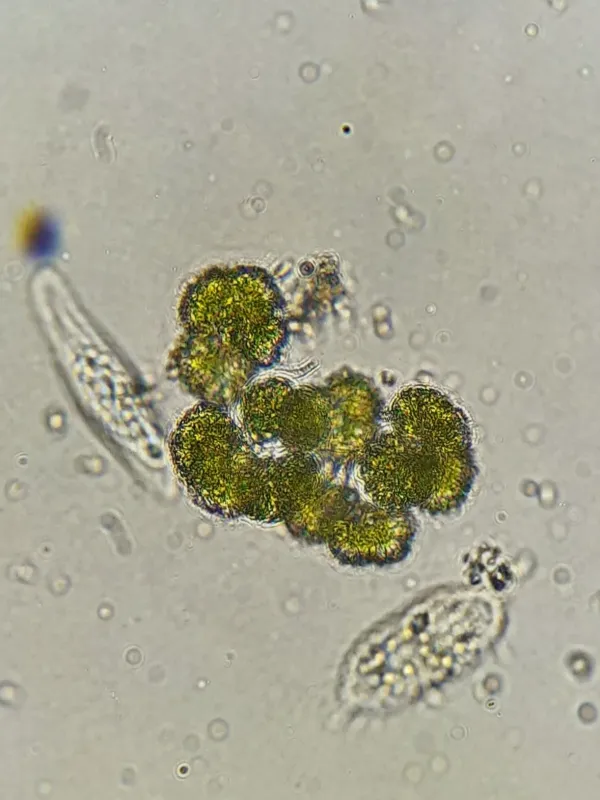
Description
Sowing dates
The inoculation of Botryococcus braunii in large-scale systems does not rely on traditional planting seasons but rather on the controlled expansion of lab-grown cultures. The initial phase involves scaling up the inoculum in smaller volumes to ensure a healthy population density.
Inoculation success depends on the chemical composition of the culture medium. Essential nutrients such as nitrates and phosphates must be provided in precise ratios to promote rapid cell division before the transition to the oil-accumulation phase.
When starting a new production cycle, it is crucial to manage the light intensity. Young cultures require moderate illumination to adapt to the reactor environment without suffering from photo-oxidative stress.
The density of the inoculum is carefully monitored; insufficient initial density may allow competing microorganisms to overtake the system. Conversely, over-inoculation can limit light penetration, stalling growth at the outset.
Continuous culture systems allow for a staggered "sowing" approach, where a portion of the population is harvested, and the remaining biomass serves as the inoculum for the next growth cycle, ensuring sustained production.
Growing requirements
Botryococcus braunii is a freshwater colonial microalga belonging to the Trebouxiophyceae class. It is world-renowned for its unique ability to store hydrocarbons, particularly botryococcenes, which can constitute a vast majority of its dry weight.
Optimal environmental conditions include temperatures ranging from 20°C to 28°C. Maintaining thermal stability is vital, as the alga's metabolic pathway for hydrocarbon synthesis is highly sensitive to fluctuations beyond this range.
Light is the primary energy source, and rigorous management of photon flux density is required. In industrial reactors, supplemental artificial lighting is often used to maintain productivity during periods of low natural light.
The cultivation medium must be maintained at a slightly alkaline pH, typically between 7.5 and 8.2. Carbon dioxide enrichment is a standard practice to boost photosynthetic rates and ensure sufficient carbon for lipid synthesis.
Water agitation is necessary to prevent the formation of stagnant zones in the reactor. Proper mixing ensures that all colonies receive equal access to light and nutrients, preventing the settlement of cells on the reactor bottom.
Yield
The yield of Botryococcus braunii is measured primarily by its hydrocarbon content, which varies depending on the specific strain and growth conditions. High-yielding strains can produce oil concentrations exceeding 70% of their total dry mass.
Productivity is often optimized through a two-stage cultivation process: a growth phase followed by an induction phase. During the induction phase, nutrient stress triggers the alga to prioritize hydrocarbon synthesis over rapid cell replication.
Advancements in tubular photobioreactors have significantly increased yields by providing superior light penetration and better control over environmental variables compared to traditional pond systems.
The extraction efficiency of the hydrocarbons from the colonial matrix is a major factor in net yield. Innovations in green solvents and supercritical fluid extraction are helping to maximize the recovery of the high-value oil fraction.
Annual yields per hectare are significantly higher for this species than for most traditional oilseed crops. This makes Botryococcus braunii a leading candidate for large-scale renewable energy production.
Main diseases and pests
Chytrid fungi are the most lethal threats to large-scale cultures. These pathogens can cause complete population collapse within a few days, making sterile inputs and water filtration essential defenses.
Interspecific competition with faster-growing green algae or cyanobacteria can compromise the culture. Strict sanitation protocols and selective medium conditions are required to maintain the dominance of B. braunii.
Grazing by zooplankton, such as rotifers or protozoa, can severely reduce biomass levels. Integrated filtration systems at the water intake stage are mandatory to prevent these predators from entering the reactor environment.
Environmental stress, such as sudden shifts in light or temperature, can trigger a defense response that lowers metabolic efficiency. Such conditions often make the culture more susceptible to secondary infections.
Chemical imbalances, such as high ammonia levels or drastic pH drops, can be detrimental. Real-time sensor arrays are used in modern facilities to detect these changes before they negatively impact the health of the culture.
Harvesting
Harvesting strategies typically involve centrifugation or tangential flow filtration. Centrifugation is highly efficient at recovering biomass but requires significant energy, making it best suited for high-value applications.
Flocculation agents are often employed to increase the density of the algal colonies, making them easier to separate from the water. This step is crucial for reducing the operational costs of large-scale water processing.
Once the algal slurry is collected, the extraction of hydrocarbons is performed. This can be achieved through solvent extraction, mechanical pressing, or thermal liquefaction, depending on the desired purity of the fuel.
The refining process converts the raw hydrocarbon extract into diesel-compatible fuels. The unique structure of the compounds produced by this alga requires specific refining catalysts to ensure engine-grade performance.
Post-extraction biomass is treated as a valuable byproduct. It contains significant protein levels and is frequently processed into animal feed or used in anaerobic digestion to produce biogas, enhancing the overall economics.