
Ethiopian wormwood
Artemisia aethiopica
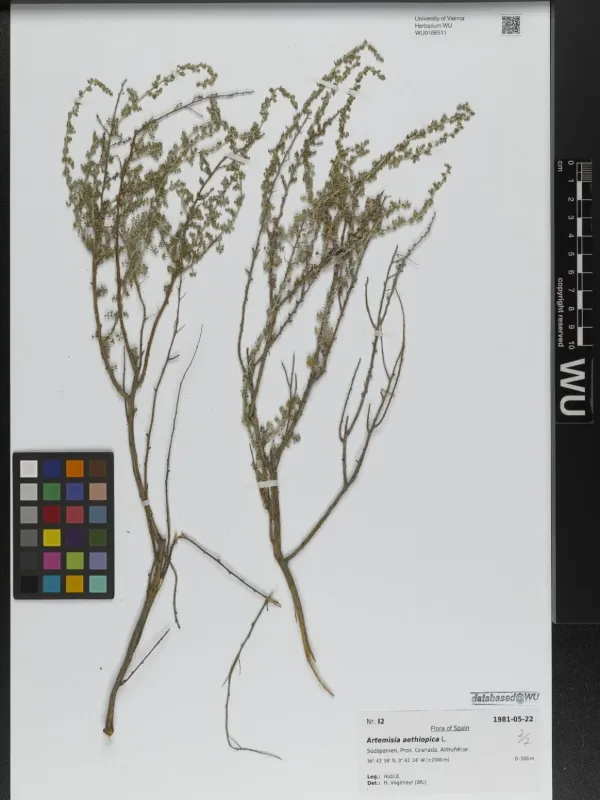
Description
Sowing dates
The sowing of Ethiopian wormwood in commercial operations is usually carried out in the spring, when the soil warms up to a temperature of 10–12 degrees Celsius. Mid-April is considered the optimal time, allowing seeds to utilize moisture from melting snow for uniform germination.
When using the seedling method, seeds are sown in greenhouses in late February or early March. This ensures the production of stronger planting material that adapts more easily when transplanted into open ground.
The sowing depth should be minimal, as the seeds are light-sensitive and very small in size. Surface sowing followed by light rolling is recommended to ensure optimal seed-to-soil contact.
The planting pattern depends on the crop's end-use and the harvesting method. For mechanized maintenance, row spacing is kept between 45 and 60 centimeters, which facilitates future crop management.
Seedlings emerge within 14–21 days after sowing, depending on temperature conditions. During this period, it is critical to maintain optimal moisture in the topsoil layer to prevent crust formation.
Growing requirements
Artemisia aethiopica belongs to the Asteraceae family and is a perennial herbaceous plant with a pronounced aromatic profile. The crop is highly demanding regarding light exposure and tolerates even slight shading poorly, which leads to a decrease in essential oil concentration.
Ethiopian wormwood prefers light, well-drained sandy loam or loam soils with a neutral to slightly alkaline reaction. Waterlogging is detrimental to this plant, as it triggers the development of root rots.
The plant exhibits high drought resistance, which stems from its evolutionary origin in arid climates. However, to obtain high-quality green biomass during the active vegetative growth phase, periodic irrigation is necessary.
The crop is not as demanding regarding soil fertility as vegetable species, but it responds positively to the application of phosphorus-potassium fertilizers. An excess of nitrogen in the soil can lead to excessive biomass growth at the expense of essential oil quality.
Optimal climatic conditions for cultivation require long daylight hours and a dry, warm period during the maturation of the inflorescences. High air humidity during the flowering phase is highly undesirable, as it reduces the yield of therapeutic components.
Yield
The yield of Ethiopian wormwood depends directly on the age of the plantation and agronomic conditions. Maximum productivity is observed in the second or third year after planting, when the bushes reach their full development.
Average yield of above-ground green biomass ranges from 10 to 15 tons per hectare, provided that the cultivation technology is strictly followed. Results may vary depending on the planting density.
The essential oil yield depends on the plant's growth stage at the time of harvesting. The highest concentration of active substances is reached during the mass flowering period, which is the determining factor for the final product's quality.
To maintain stable yields over several years, rejuvenating pruning must be performed. This stimulates the formation of new shoots and prevents the degeneration of the wormwood stands.
The economic efficiency of the crop is ensured not only by the volume of biomass but also by the qualitative characteristics of the raw material. Analysis of the oil composition and its application in the cosmetic industry dictates modern requirements for marketability.
Main diseases and pests
The main threats to Ethiopian wormwood are fungal diseases that develop when humidity levels are not properly managed. Late blight and powdery mildew can significantly reduce raw material quality by damaging leaves and stems.
Among pests, various types of leaf beetles and aphids pose the greatest danger, feeding on young, succulent shoots. Large-scale insect infestations can significantly inhibit crop growth.
To prevent the spread of pests, adherence to crop rotation and spatial isolation from wild species of the genus Artemisia is recommended. This reduces the risk of transferring infections and pests to cultivated crops.
Chemical protection of fields should be approached with caution, given the specific use of the plant in pharmacology and cosmetics. Preference is given to biological control methods if they do not conflict with cultivation regulations.
Monitoring the condition of plantations should be carried out weekly, especially during periods of unstable weather. Early detection of disease signs allows for the containment of outbreaks and minimizes harvest losses.
Harvesting
Harvesting of Ethiopian wormwood takes place during the mass flowering phase, when the essential oil content in the tissues reaches its peak. At this time, the plant possesses its strongest and most stable fragrance.
Cutting is performed mechanically, using mowers equipped with attachments for collecting the harvested mass. It is crucial to cut the stems at a height of 10–15 centimeters from the ground to avoid damaging the plant's root system.
After cutting, the raw material must be processed or dried immediately. Delays in delivery to processing facilities lead to the loss of volatile essential oil components, directly reducing the value of the harvested crop.
Drying is carried out in specialized drying units at temperatures not exceeding 40 degrees Celsius to preserve the structure of the active substances. In natural conditions, drying should take place under a canopy in the shade, away from direct sunlight.
Properly dried raw material retains a grayish-green hue and a specific scent. The finished product is packed in airtight containers to prevent the evaporation of aromatic compounds during storage.