
Low sandwort
Arenaria humifusa
Description
Growing requirements
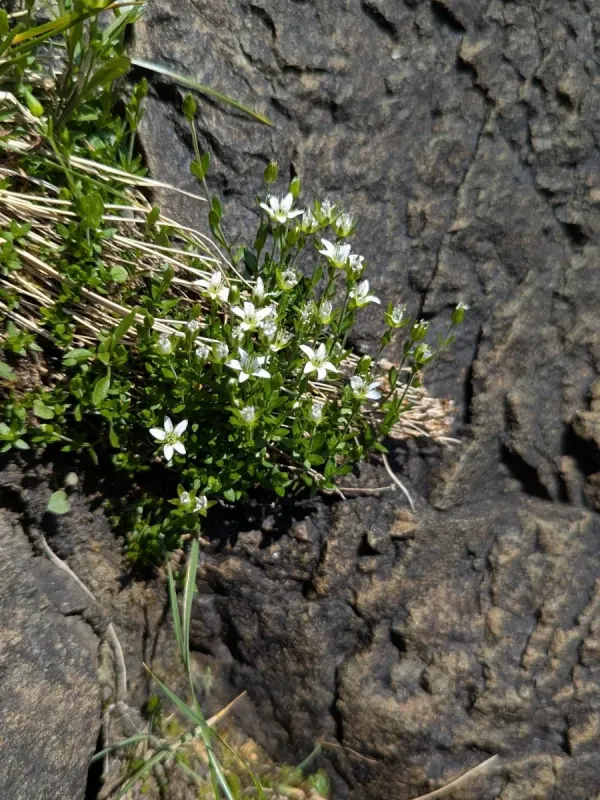
Low sandwort (Arenaria humifusa) is a perennial herbaceous plant belonging to the Caryophyllaceae family. It is typically characterized by a low-growing, mat-forming habit, which allows it to thrive in harsh, exposed, and wind-swept environments characteristic of alpine and arctic tundra regions.
Botanically, the plant features small, simple, and opposite leaves, accompanied by small white flowers that emerge during the short growing season. The root system is specifically adapted for anchoring in rocky crevices and loose stony substrates, allowing the plant to stabilize itself on challenging slopes.
The geographic distribution of this species spans arctic regions and high-altitude areas in North America and Greenland. It is highly selective of its habitat, thriving primarily on open, sparsely vegetated limestone barrens where competition from more robust plant species is minimal or non-existent.
Regarding cultivation requirements, the species demands extremely well-drained, nutrient-poor, and slightly alkaline soils. It is highly sensitive to moisture accumulation around the crown, which can lead to rapid decay; therefore, maintaining a porous substrate is essential for the plant's long-term survival.
The plant is a strict heliophyte, requiring full exposure to sunlight to maintain its dense growth structure. Any form of shading from surrounding vegetation or human-induced environmental changes significantly reduces its vigor and limits its ability to reproduce effectively within its ecological niche.
Main diseases and pests
Primary threats to the species include climate-driven vegetation shifts that encroach upon its open habitat. While generally resilient to extreme weather, the plant is vulnerable to root rot if placed in poorly drained or overly humid conditions, which effectively prevents its widespread use in standard garden soils.