
Early hair-grass
Aira praecox L.
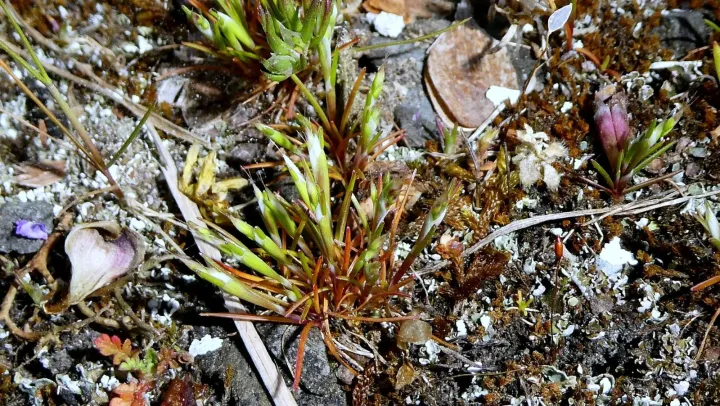
Description
Growing requirements
The early hair-grass (Aira praecox) is a slender annual grass belonging to the Poaceae family. It is a classic ephemeral species that completes its lifecycle before the onset of summer drought.
Native to Europe and parts of Western Asia, this grass is predominantly found in acidic, sandy soils. It thrives in open, sunny habitats such as heathlands, coastal dunes, and dry pastures where vegetation is sparse.
The species requires high levels of light to initiate growth. It is highly intolerant of shade and will quickly disappear if overgrown by taller or more competitive vegetation.
Regarding soil conditions, it prefers well-drained, nutrient-poor substrates. It is often considered a pioneer species, capable of colonizing disturbed or degraded land where other plants fail to establish.
Its climatic requirements are centered around the oceanic climate of Europe, characterized by mild winters and moist springs. It does not possess significant drought resistance, instead relying on its early phenology to avoid dry periods.
Main diseases and pests
The early hair-grass does not face significant pressure from agricultural pests, as it is not a cultivated crop and offers little nutritional value compared to primary forage grasses.
Fungal pathogens such as rusts might occur in very wet seasons, but the rapid growth cycle usually allows the plant to set seeds before any infection can cause systemic failure.
The primary threat to its existence is land use change. Increased nitrogen deposition and agricultural intensification significantly reduce the population of this grass by favoring more aggressive competitive species.
Herbivory pressure is generally low, although occasional grazing by livestock can help maintain the open character of the habitat necessary for the species to thrive.
Lack of habitat diversity and over-management of grasslands pose the greatest risk to its conservation, as the species relies on soil disturbances to expose bare ground for germination.