
Agathophora alopecuroides
Agathophora alopecuroides
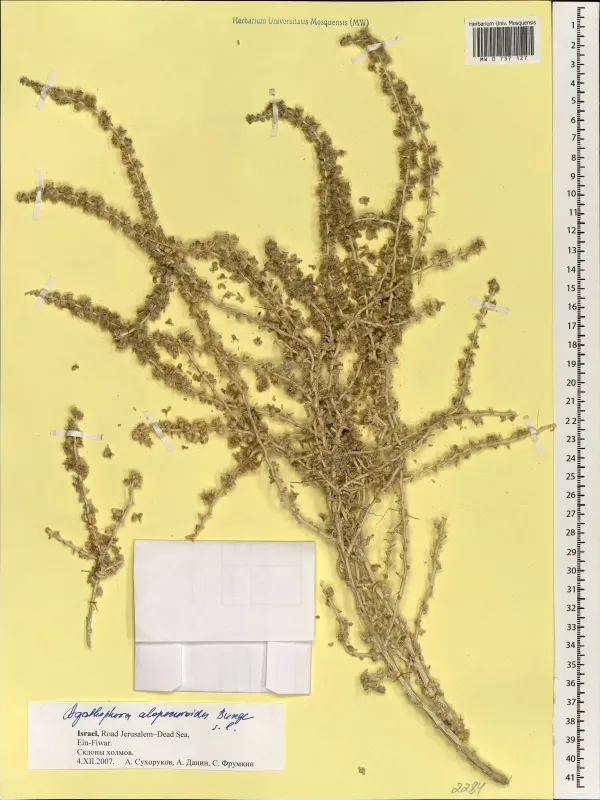
Description
Growing requirements
Agathophora alopecuroides is a distinctive subshrub belonging to the Amaranthaceae family, known for its extreme resilience in arid environments. This plant is well-adapted to the harsh conditions of desert and semi-desert ecosystems.
Botanically, it is recognized as a halophyte, meaning it can thrive in highly saline soils where agricultural competition is minimal. Its morphological structure, including specialized leaves, is specifically evolved to minimize water loss through transpiration.
The plant requires well-drained, sandy, or alkaline soils to establish its extensive root system. It thrives in regions with intense sunlight and is highly tolerant of the extreme temperature fluctuations characteristic of its native habitats.
Agathophora is naturally distributed across North Africa and the Middle East. It has evolved to survive in areas where rainfall is sporadic, utilizing even the smallest moisture events to maintain metabolic processes.
In terms of agricultural management, the plant requires minimal intervention. It does not tolerate shading, making it unsuitable for intercropping with dense vegetation, but it excels in open desert landscapes where competition is low.
Yield
The primary economic utility of Agathophora alopecuroides is as a forage source for camels and small ruminants. It provides essential grazing material during peak dry seasons when other vegetation types are unavailable.
The nutritional profile of this plant is sufficient to support livestock during periods of scarcity, acting as a critical buffer for desert farming communities. Its ability to remain green during droughts makes it a reliable feed resource.
Productivity is closely linked to grazing pressure. Sustainable land use practices are essential to ensure the longevity of the plant population, as overgrazing can lead to the deterioration of the soil cover.
Beyond its value as fodder, the plant plays a crucial environmental role in soil stabilization. By binding sandy soils with its root structure, it serves as a natural defense against wind erosion and helps mitigate desertification.
Harvesting strategies for this culture primarily involve the collection of seeds for range restoration projects. Given its biological robustness, it remains a focal point for researchers working on sustainable land development in arid zones.