
Crop Production
On the Effectiveness of Soybean Seed Inoculation
Soybean is becoming increasingly popular crop in Russia. Its sown area over the past 5 years (from 2005 to 2011) has increased by 60% (from 718 to 1160 thousand hectares). The Far East remains the main soybean producer, but stable growth in popularity is also observed in the southern European part of the Russian Federation. Thus, in the Krasnodar region, its sown area has already reached more than 140 thousand hectares (4% in structure), or 12% of the total Russian area. Interest in soybean is also growing in other southern regions: in Rostov region (24.7 thousand hectares) and in Stavropol region (32.6 thousand hectares).
Soybean is becoming increasingly popular crop in Russia. Its sown area over the past 5 years (from 2005 to 2011) has increased by 60% (from 718 to 1160 thousand hectares). The Far East remains the main soybean producer, but stable growth in popularity is also observed in the southern European part of the Russian Federation. Thus, in the Krasnodar region, its sown area has already reached more than 140 thousand hectares (4% in structure), or 12% of the total Russian area. Interest in soybean is also growing in other southern regions: in Rostov region (24.7 thousand hectares) and in Stavropol region (32.6 thousand hectares).
Nitrogen-fixing bacteria of the genus Rhizobium are soil-dwelling and are associated with the natural distribution areas of corresponding leguminous plants. Since soybean is native to China, its symbiotic bacteria — Bradyrhizobium japonicum — are present in natural biocenoses only in Southeast Asia. On the majority of the territory of our country, specific native soybean nitrogen-fixing bacteria Bradyrhizobium japonicum do not exist. Of course, in areas of systematic cultivation of host plants, local populations of corresponding rhizobia form, but they are constantly subjected to adverse weather conditions, destroyed by pesticides and intensive soil tillage, which does not allow them to establish a stable population on new sites. The fact that soybean occupies only a minor share in the structure of sown areas in southern Russia (4% in the Krasnodar region, and no more than 1% in other southern regions) and that soybean bacteria do not exist in the natural soil biocenosis leaves no doubt about the necessity of artificial inoculation (inoculation) of soybean seeds with cultural Bradyrhizobium japonicum.
The company «Agroliga Russia» has registered and for the past two years successfully implemented liquid inoculant Noktin A of Argentine production. Noktin A is supplied to the USA, Brazil, Argentina, Paraguay, other countries of Latin America, India, China, and others. The area sown worldwide with seeds treated with inoculants from the company «Sintesis Kimika» exceeds 14 million hectares. In Russia, Noktin A has already, in its second year of application, earned recognition among soybean producers (every tenth hectare of soybean in 2011 was sown with seeds treated with this inoculant, in the Krasnodar region — every fifth).
Studies to determine the effectiveness of applying liquid inoculant of Argentine production, Noktin A, were conducted under field conditions at the experimental plot of the Department of Plant Physiology and Biochemistry of Kuban State Agrarian University.
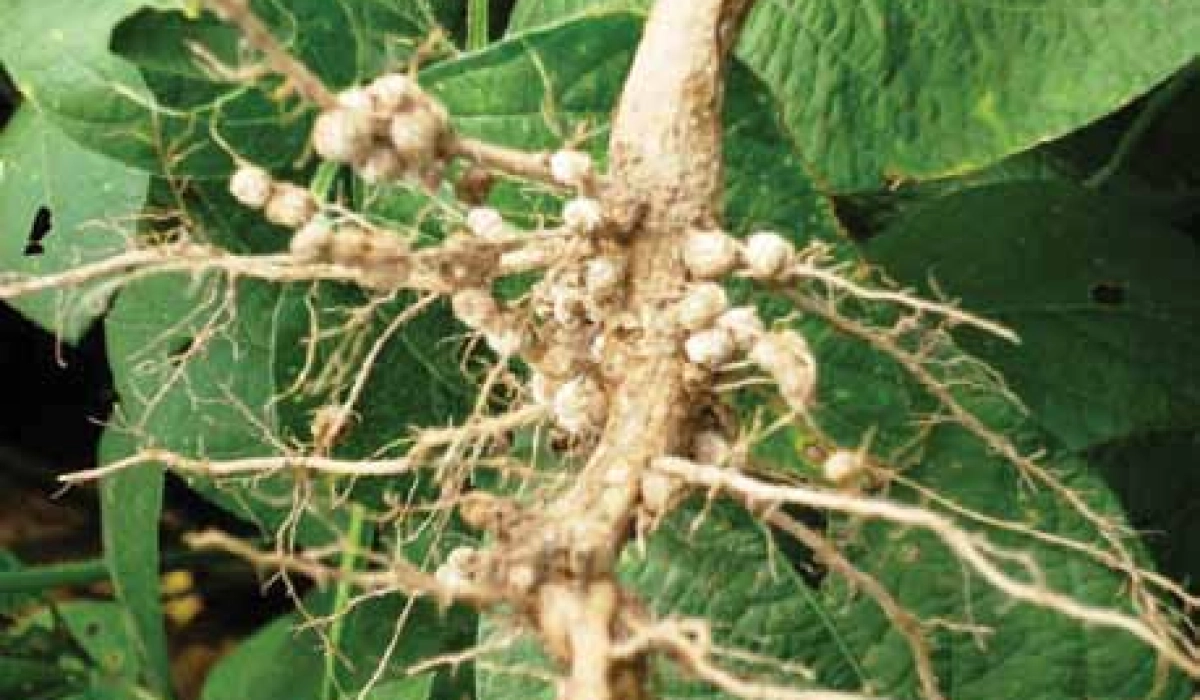
Inoculation of soybean seeds with inoculants promoted the formation of nitrogen-fixing nodules. The most active nodule formation occurred in the variant with application of inoculant Noktin A: their mass compared to the control was 2.2 times greater, and compared to the standard (Rizotorfin) — 25%.
Treatment of seeds with Noktin A stimulates growth processes (plant height) and positively affects the photosynthetic potential of plants (number of leaves and leaf surface area). According to these indicators, in the flowering and seed development phase, the variant with Noktin A surpassed the control by 25% and the standard variant — by 14%.
Nodule development and, consequently, the ability to use atmospheric nitrogen intensifies nitrogen nutrition and allows plants to more efficiently form vegetative mass and reproductive organs, to lay down more branches and pods. As a result, more large and mature seeds are formed; the number of seeds per plant in the variant with Noktin A is twice that of the control and 1.3 times that of the standard. The mass of 1000 seeds after treatment with Noktin A is also higher than in the control and after treatment with Rizotorfin.
Summarizing the scientific and practical data obtained by specialists of «Agroliga Russia», it is clear that inoculation of soybean seeds with inoculants increases the number and mass of nitrogen-fixing nodules on soybean roots, increases the active symbiotic potential of the plant. As a result, the yield of pods increases, and the protein content increases.
The effectiveness of symbiotic nitrogen fixation, along with the activity of rhizobial strains, is ensured by agro-ecological conditions of soybean cultivation:
• soil moisture (formation of nitrogen-fixing nodules occurs in the range of 40 — 80%, and optimally — 60 — 70% of soil water capacity);
• soil aeration (reduced oxygen access worsens nitrogen fixation);
• soil pH (high soil acidity greatly negatively affects the activity of nodule bacteria, optimal pH is not lower than 5.5 — 6.0);
• soil and air temperature (nitrogen fixation intensity sharply decreases both at lower and higher temperatures, optimal temperature for effective nitrogen fixation by soybean rhizobia is around 20 — 30°C);
availability of accessible phosphorus for plants (at low phosphorus content in the medium, bacteria penetrate the root, but nodules are not formed. The maximum number of nodules on soybean roots forms at medium (25 mg/kg) phosphorus soil availability);
• availability of molybdenum and other microelements activates rhizobial activity; molybdenum is especially necessary on acidic soils (pH 5.3 — 5.4), where its application increases the number and mass of nodules on soybean roots by 1.5 — 2 times.
The greatest controversy arises regarding the advisability of providing soybean plants with mineral nitrogen. Based on numerous laboratory and field experiments, it is known that the more nitrogen-containing compounds in the surrounding medium, the more difficult it is for bacteria to penetrate the root.
Soybean has two types of nitrogen nutrition: symbiotic (nitrogen uptake from the air with the help of nodule bacteria living on soybean roots) and autotrophic (nitrogen uptake from fertilizers and soil). Soil and symbiotic sources of nitrogen nutrition complement each other, usually being in a mutually compensatory relationship. When there is sufficient mineral nitrogen in the soil, soybean primarily absorbs it autotrophically, especially in the absence of soybean nodule bacteria. In this case, fewer nodule formations occur on the roots or they do not form at all. Deficiency of available nitrogen in the soil, especially in the early growth stage of plants (when nodules form on soybean roots), leads to dominance of the symbiotic type of nutrition (number of nodules increases), provided that the soil contains virulent nodule bacteria. Therefore, mineral nitrogen in the soil is not the primary limiting factor for soybean. The majority of scientists' opinion reduces to recommending initial nitrogen application before sowing (15 — 30 kg/ha) to improve growth in the early stages.
Technological violations during the inoculation process can significantly reduce its effectiveness. Inoculation with the inoculant is carried out immediately before sowing. Seed treatment with fungicides should be conducted 1 — 2 weeks prior to inoculation, except for fungicides based on D.W. benomyl (fundazol). Inoculation is performed indoors, where direct sunlight does not penetrate, as sunlight is detrimental to nodule bacteria. Diffuse light does not impair their activity. It is very important that seeds be sown immediately after treatment, and preferably into moist soil. Inoculated seeds should not be stored for long; they must be sown on the same day, preferably immediately after treatment. Nodule bacteria require a moist environment. Therefore, seeds should be treated with the inoculant in an amount calculated for sowing on the same day. If inoculated seeds cannot be sown promptly, they should be re-inoculated on the day of sowing.
Strongly reduce the effectiveness of inoculation and decrease the number of nodules on soybean roots not only sunlight, but also rapid death of rhizobia upon drying of the seed surface, as well as shedding (blown off by wind) of dry particles of peat substrate from the smooth surface of seeds during transportation, filling into the seeder, etc. When using liquid inoculants, problems with retaining bacteria on soybean seeds generally do not arise. However, in any case, bacteria are living organisms and require protection from drying out and nutrition during the initial period of their development.
Excellent results were obtained from the combined application of liquid inoculant Noktin A and specialized seed bio-stimulant Feritgreen Start (produced by the company «Agritechno Fertilizantes», Spain). Its composition includes free amino acids of plant origin, nitrogen, and extracts of marine algae, which accelerate seed germination, improve root system development, and provide the plant with necessary nutrition during early development stages.
In addition, Feritgreen Start contains nutrients for bacteria (sugars and polysaccharides), creating optimal conditions for rhizobial development. The preparation has adhesive properties, which improve the attachment of bacteria to seeds and protect bacterial cells from drying out. Combined application of the preparations enhances bacterial viability after inoculation, increases the number and size of nodules, and improves nitrogen fixation conditions.
Pre-sowing treatment of seeds with inoculants and bio-stimulants confirms their effectiveness even in regions where Bradyrhizobium japonicum bacteria are native, and soybean is grown practically as a monoculture, which is typical for the Far Eastern Federal District of the Russian Federation, where 65% of soybean sown area in the country is located. Thus, in the Khabarovsk region, soybean share in sown area in 2011 was 19%, Primorsky Krai — 43%, Amur Oblast — 66%, Jewish Autonomous Oblast — even 70%.
Yield increase was achieved through increased number of pods and seeds per plant. When seeds were treated only with inoculant, soybean yield increased by 30%, and when treated with Noktin A and bio-stimulant Feritgreen Start — by 38%.
In production experiments from 2009 to 2011, conducted by specialists of the «Agroliga Russia» group on various soybean varieties in soybean farms of the Far East, the yield increase from pre-sowing seed treatment with Noktin A and Feritgreen Start ranged from 10% to 35%. Similar results were obtained in the Krasnodar region, Belgorod region, and other soybean cultivation regions.
The need for microelements often manifests itself at the earliest stages of plant development. Pre-sowing treatment is a simple and effective method of applying microelements. It has several advantages, as it ensures plants with microelements at the very beginning of growth, activates physiological and biological processes, saves microfertilizer expenditure, and reduces soil pollution.
The most important microelement for soybean in early development stages is molybdenum. Molybdenum plays a specific role in atmospheric nitrogen assimilation by leguminous crops, especially necessary in early stages of soybean development. Its role in intensifying symbiotic nitrogen fixation of leguminous crops (promotes more intensive growth of nodule bacteria) and improving nitrogen nutrition of subsequent crops is very important. When seeds of soybean are inoculated with rhizobial bacteria strains together with molybdenum, the activity of symbiotic nitrogen fixation increases several times.
Successful scientific and production tests of soybean seed treatment before sowing passed a new organo-mineral fertilizer Teknokel Amino Mo (manufacturer «Agritechno Fertilizantes», Spain), which since 2012 has been included in the «List of Pesticides and Agrochemicals...». The composition of Teknokel Amino Mo includes 8% water-soluble molybdenum and 4% free amino acids. Due to its composition, this fertilizer can be applied both for pre-sowing seed treatment and for foliar feeding during soybean and other leguminous crop vegetative growth.
Testing of the fertilizer Teknokel Amino Mo was conducted at the experimental base of VNIIZBK (city of Orel) in the dry year 2010 on the variety of soybean 'Lancetnaya'. Pre-sowing seed treatment was carried out at the rate of 2 liters/ton, and spraying of crops at the stages of 4 — 6 leaves and budding — beginning of flowering at the rate of 0.2 liters/ha. Treatment of seeds with molybdenum contributed to increased energy of germination (up to 5%) and accelerated emergence of seedlings (by 2 — 3 days). The yield increase from using Teknokel Amino Mo for seed treatment and foliar feeding amounted to 13.5% due to increased number of pods (by 12 — 16%) and seeds in pods (up to 15 — 17%).
Specialists of «Agroliga Russia» developed and proposed for production a comprehensive pre-sowing seed treatment scheme for soybean:
1. Liquid inoculant Noktin A (1.5 — 3 liters/ton);
2. Bio-stimulant Feritgreen Start (0.5 — 1.25 liters/ton);
3. Fertilizer Teknokel Amino Mo (2 liters/ton).
All products are liquid, which does not create problems with preparing the working solution, and are very convenient for mechanized seed inoculation.
Testing the effectiveness of the full seed inoculation scheme was conducted in 2010 in demonstration production trials of the Department of Plant Physiology and Biochemistry of Kuban State Agrarian University on rice checks in the ZAO «RivAgro» of Temryuk district, Krasnodar region. Soybean seeds of the variety 'Vilana' were treated with a mixture of the preparations (Noktin A — 3 liters/ton, Feritgreen Start — 1 liter/ton and Teknokel Amino Mo — 2 liters/ton), while control seeds were untreated. Weather conditions were unfavorable for plant growth and development: heavy rains formed water layers up to 5 — 7 cm deep, creating temporary anaerobic conditions. As a result, as of July 14 (flowering stage), no root nodules were detected on the control variant, while on the treated plot there were 63 nodules per plant (total mass 2.09 g), including 40 large nodules.
Enhanced fixation of atmospheric nitrogen by plants promoted activation of growth processes and positively affected the photosynthetic activity of plants. Plants on the treated plot were taller (67.9 cm, control — 59.9 cm), the number of leaves per plant increased (from 20.3 to 23.7), accordingly, the leaf area increased (from 246.3 to 278.3 cm2).
On treated plants, more pods (38.7 per plant, control — 30.8) and seeds (99.9 and 87.8 respectively) formed, seeds were larger (mass of 1000 seeds 142.9 and 136.2 g respectively). Due to heavy rains at the beginning of vegetation and hot, dry weather in the second half of the season, soybean yield was low — 15.9 centners/ha on the treated plot and 13.9 centners/ha on the control (increase of 2.0 centners/ha, or 14.4%). In the experimental variant, seeds were more large and high quality (oil content — 21.6%, control — 21.3%). Overall oil yield per hectare from treating seeds according to the proposed scheme increased by 15.9%.
In addition to the described scheme for combined inoculation of soybean seeds, the «Agroliga Russia» group offers comprehensive foliar feeding schemes, as well as a full range of plant protection products from leading foreign manufacturers, consulting and agricultural support services for agricultural enterprises.
O. SAVENKO, Candidate of Agricultural Sciences.