
Kitchen scales for greenhouse farming: control of fertilizers, seeds, and harvest
In greenhouse farming, precise weighing is needed not only for finished products but also for daily work with seeds, fertilizers, substrates, and plant care products.
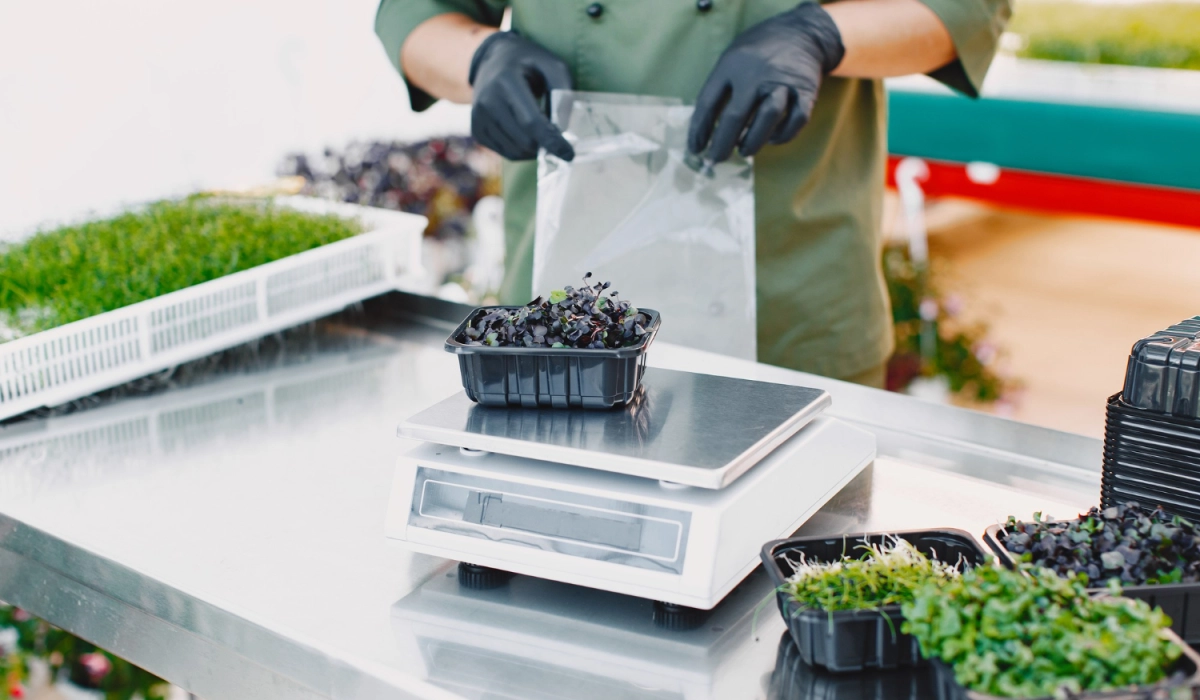
In greenhouse farming, precise weighing is needed not only for finished products but also for daily work with seeds, fertilizers, substrates, and plant care products. When a farmer calculates application rates, prepares small batches of planting material, or packs the harvest, tabletop scales help reduce errors and make processes more controlled.
Where scales are useful in a greenhouse
In greenhouse production, many operations are performed in small batches. This is especially noticeable when growing seedlings, herbs, tomatoes, cucumbers, peppers, and other crops where uniform nutrition, precise dosing, and accounting for harvested produce are important.
Scales help control not only large volumes but also small daily processes. For example, they can be used to quickly measure the required amount of seeds for sowing, calculate the weight of fertilizer for preparing a solution, check the weight of packaged finished products, or compare the yield of different beds and varieties.
Control of fertilizers and nutrient mixtures
When working with fertilizers, accuracy is especially important. An excess of nutrients can cause plant stress, while a deficiency reduces growth rates and harvest quality. For small greenhouses, farms, and seedling departments, electronic models with a measuring step of 1 g or 0.1 g are convenient.
High-precision models are suitable for microelements, stimulants, dry mixtures, and components added in small doses. If the farm more often works with substrate, ready vegetables, or larger batches of products, it is better to choose scales with a maximum load of 5, 7, or 10 kg.
Seeds, seedlings, and planting material
Before sowing, it is important to understand how many seeds are used for a certain area, tray, or cassette. This helps plan purchases, estimate remaining stock, and calculate the cost of future seedlings more accurately.
For small seeds of herbs, lettuce, radish, tomatoes, or peppers, compact electronic scales are especially useful. They allow working with small volumes without measuring material by eye. With regular sowing, this reduces overspending and makes the technology more predictable.
Packing and harvest accounting
After harvesting, scales are needed for sorting, packing, and preparing products for sale. In greenhouse farming, this may include bunches of herbs, berries, vegetables, aromatic herbs, microgreens, or small batches of seedlings in containers.
- models with 1 g accuracy are suitable for packing herbs and berries;
- for fertilizers and microelements, it is better to choose high-precision models with a 0.1 g step;
- for vegetables and substrate, scales with a load capacity of up to 7 or 10 kg are convenient;
- for humid conditions, it is worth paying attention to the platform material and ease of cleaning;
- for frequent use, tare function, an LCD display, and a stable base are useful.
Platform or bowl
Scales with a platform are convenient for boxes, containers, bags, seedling cassettes, and packages with finished products. They make it easier to weigh irregularly shaped containers, especially if the farm uses different types of packaging.
Models with a bowl are well suited for seeds, granular fertilizers, dry mixtures, berries, and small vegetables. The bowl helps prevent material from spilling and speeds up work when small portions need to be measured frequently.
Which characteristics to consider
When choosing a model for greenhouse farming, it is worth considering not only the price but also the actual tasks. High accuracy is important for sowing material, sufficient maximum load is important for packing the harvest, and ease of cleaning, a reliable body, and a readable display are important for everyday work.
Power supply also matters. Battery-powered scales are convenient where there is no permanent workplace or outlet near the packing area. For stationary work, models with a larger platform, stable body, and tare function can be chosen.
Practical value for the farm
Accurate scales in a greenhouse help reduce overspending on seeds and fertilizers, better control harvest batches, and prepare products for sale faster. This is a simple tool that improves accounting discipline and makes plant care more stable.
For a small farm, one universal model up to 5 or 10 kg is enough. If the greenhouse is actively engaged in seedlings, packing, and preparing nutrient mixtures, it is better to have two models: a high-precision one for small dosages and a higher-capacity one for harvest and containers.
Taring when working with containers and packaging
In greenhouse farming, products are rarely weighed without packaging. Plastic containers, bags, cassettes, buckets, trays, or small boxes are most often used. That is why the tare function becomes one of the most useful features in daily work. It allows the weight of the packaging to be reset to zero and the net weight of seeds, fertilizer, substrate, or harvested produce to be obtained.
This is especially convenient when packing herbs, microgreens, berries, and vegetables, where each batch must have the same weight. The worker places the container on the platform, resets the reading to zero, and then adds products to the required value. This approach speeds up order preparation and reduces the risk of underweight packages or overspending.
Body and platform material
For a greenhouse, it is important to choose scales that are easy to clean from dust, soil particles, moisture, and plant residues. A glass or metal platform is convenient for quick wiping, while plastic models often have advantages in terms of lightness and price. If the scales are used near the packing area or the solution preparation area, it is advisable to choose a simple design without hard-to-reach places where dirt can accumulate.
When working with wet products, it is important to make sure that water does not get inside the body. Even if the scales are used only for kitchen and farm tasks, regular cleaning and careful storage help extend the service life of the device.
Accuracy as an element of technological discipline
Greenhouse cultivation depends on repeatable processes. If fertilizers, seeds, and nutrient components are measured approximately every time, the result may differ from batch to batch. Accurate scales help establish working standards and make plant care more stable.
This is useful not only for large farms but also for small greenhouses where the owner independently handles sowing, feeding, harvesting, and packing. When all operations are recorded by weight, it is easier to analyze expenses, compare yields, and understand which decisions give the best result.
Using scales in the seedling department
In the seedling department, scales help control the preparation of soil mixtures, dosage of additives, and the amount of seeds. When growing seedlings for sale, this is especially important because uniform sowing and nutrition affect the appearance of plants, root system strength, and marketability of the batch.
If the farm works with different crops, scales make it easier to switch from one batch to another. Tomatoes, peppers, cucumbers, herbs, and flower seedlings may require different sowing rates and different mixture compositions, so precise weighing helps avoid mixing up recipes and maintain stable quality.
Control of production cost
Scales also help calculate production costs more accurately. When the weight of used seeds, fertilizers, substrate, and finished products is known, it is easier to estimate the actual costs of cultivation. This is important for farmers who sell their harvest in small batches, work with stores, markets, cafes, or regular customers.
For example, when packing herbs or berries, it is possible to understand exactly how much product went into each package and how many finished units were obtained from the harvested batch. Such accounting helps plan prices, control remaining stock, and avoid chaotic sales without clear profitability.
Which model is suitable for different tasks
For seeds, microelements, and stimulants, it is better to use compact high-precision scales. For packing herbs, berries, and small vegetables, an electronic model with 1 g accuracy is suitable. For substrate, boxes, and heavier products, it is worth choosing scales with a reserve in maximum load capacity.
The optimal option for greenhouse farming depends on the scale of work. A small greenhouse may be fine with a universal model, while a farm with seedlings, regular fertilizing, and harvest packing will find it more convenient to divide tasks between two devices: one for precise dosages and the other for finished products and containers.