
Applications of Cold Neon
Neon strips – a universal flexible material that can be used under various conditions. It is not afraid of low temperatures, does not shatter like glass, can bend in any direction. It is easy to cut and install.
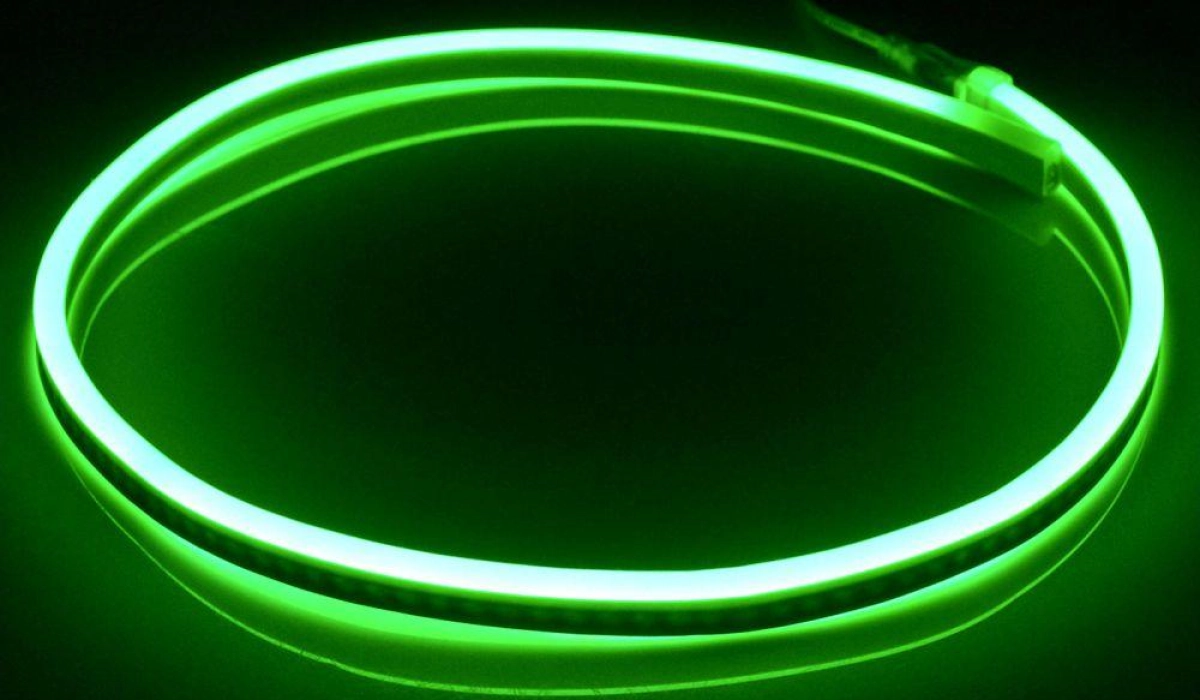
Neon strips – a universal flexible material that can be used under various conditions. It is not afraid of low temperatures, does not shatter like glass, can bend in any direction. It is easy to cut and install.
Flexible neon has replaced glass tubes filled with gas, which were used in the 19th century to create colorful signs. Inside its housing are super-powerful LEDs. The casing is made of transparent or semi-transparent polyvinyl chloride.
Where is neon lighting applied?
Devices are suitable for use in various fields:
- decorative design of commercial, office, and residential buildings;
- outdoor advertising;
- landscape design;
- highlighting architectural objects.
They can be used even in places with high humidity, such as kitchens, bathrooms, saunas, pools. In dry rooms, it is more rational to install the more budget-friendly neon LED strip.
Cold neon is an excellent option for highlighting architectural solutions. It allows illuminating outdoor decorative elements, building outlines. It can be mounted on vehicles, assembled into festive illumination. In some cases, thin neon tubes are even used to decorate clothing.
Reliable water resistance allows using flexible neon for highlighting gazebos, artificial water bodies, tree trunks, and trails. In advertising, it is used for decorating stores, cafes, shop windows, creating signs, 3D letters, moving images. Many entrepreneurs have long adopted it, as it attracts attention to the point of sale, products.
How to install flexible material?
Installing neon lighting is very simple. First, mark the space where the profiles will be mounted. These profiles, after being secured, will house the wire in the position that should also be planned in advance. Auxiliary materials for installing lighting include only the power cable, which acts as a current converter.
What are the advantages and disadvantages of LED neon?
LED material has a large number of advantages that make it popular among users:
- The material is durable and flexible. These two qualities allow implementing any design ideas.
- Flexible neon can operate within a wide temperature range. The numbers fluctuate between -40 and +60 °C. This nuance indicates that it performs well in heavy frost and extreme heat.
- LEDs do not heat up, so LED neon constructions are fire-safe and reliable. They also do not contain tiny particles or glass.
- Manufacturers guarantee a long service life of neon strips. Continuous operation is possible for several years.
- The item is resistant to aggressive environments and moisture penetration. High protection level allows its use both indoors and outdoors, including in saunas, pools, baths, etc.
- The absence of infrared and ultraviolet radiation in its composition makes it environmentally safe.
- LED neon strip is more reliable than a casing with colored pigment. At the same time, the color is visible only when the structure is turned on.
Are there any disadvantages to such lighting? There are few, and they are insignificant. The material cannot be used as a primary source. Dust accumulates quickly on its surface, which is hard to miss. Therefore, for beautiful lighting, you will have to regularly fight dust.