
Leaf
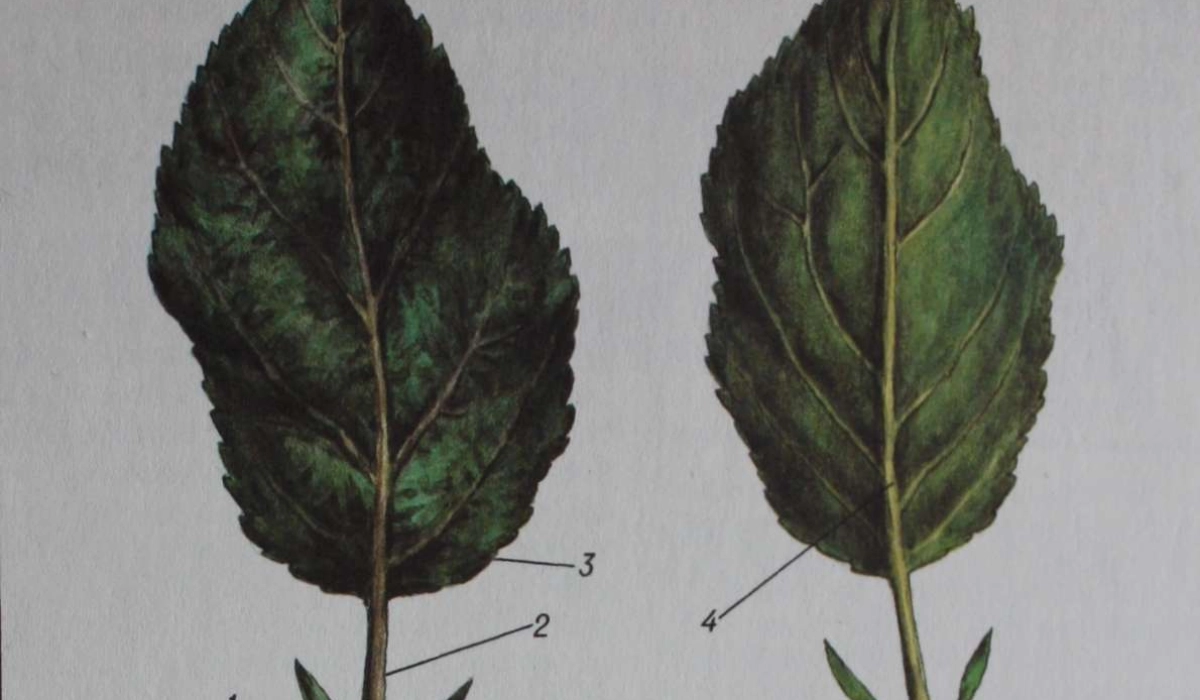
All vegetative and generative formations during the vegetation period bear leaves. The leaf is one of the most important vegetative organs of a plant. Botanically, it is considered part of the shoot.
All vegetative and generative formations during the vegetation period bear leaves. The leaf is one of the most important vegetative organs of a plant. Botanically, it is considered part of the shoot.
If the leaf blade is cut across, under the microscope you can see dense protective tissues — the epidermis. Between these tissues is the parenchyma. It is heterogeneous. Under the upper epidermis lies the palisade parenchyma, whose cells are elongated and tightly adjacent to each other. They may form two to three layers if the lighting conditions during leaf formation were sufficiently good, or one layer if there was little light during growth. Photosynthesis light curves show that the leaf is most productive under the lighting conditions in which it formed and grew.
Under the palisade parenchyma lies the spongy parenchyma. The cells of this tissue have an irregular shape. Between them there are free spaces — intercellular spaces, connected to each other, and through openings in the lower epidermis of the leaf (stomata) to the external air. This tissue is better adapted for transpiration and gas exchange.
The first leaves, regardless of the length and type of shoot on which they formed, are usually small — barely reaching 3...5 cm2. This is a reasonable adaptation of the tree to achieve the highest possible productivity. Leaves that finish growth early begin forming reserve assimilates earlier. Subsequent leaves are larger. They can reach areas of up to 80 cm2 and more. Almost directly dependent on the size of the leaf area is the length of the internode above which this leaf is located, and the mass of the bud in the axil.

of which it is located. Large leaves are generally the largest suppliers of assimilates.
The productivity of photosynthesis of an individual leaf depends on its level of illumination, water availability, and mineral nutrients, as well as on optical and physiological properties determined by its anatomical structure.

Fig. 24. Leaf: 1 — stipules; 2 — petiole; 3 — leaf blade; 4 — midrib.
Fig. 25. Anatomical structure of 'light' (A) and 'shade' (B) leaves: 1 — epidermis; 2 — palisade mesophyll; 3 — spongy mesophyll; 4 — intercellular spaces; 5 — stomata.
