
Generative Formations
Generative formations include branches most adapted and most prone to forming generative buds. Certain categories of branches are considered generative, even if they may not have flower buds.
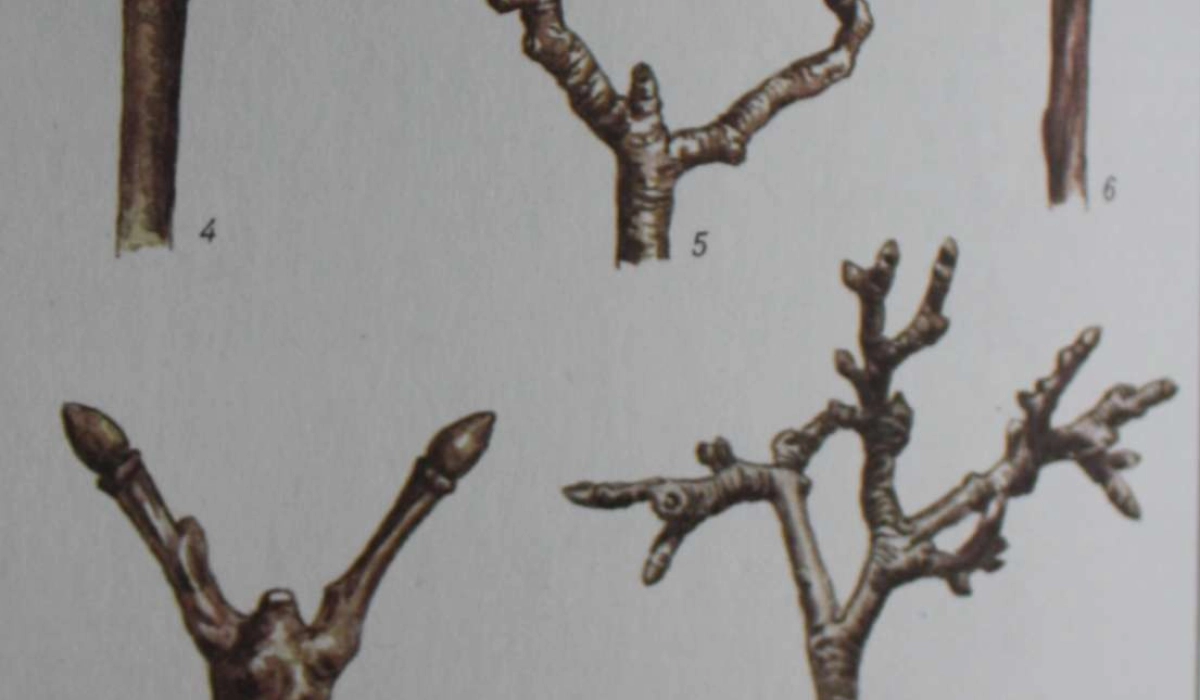
Generative formations include branches most adapted and most prone to forming generative buds. Certain categories of branches are considered generative, even if they may not have flower buds. These are fruiting spurs, spear-like branches, and knuckle branches.
A fruiting spur is a thin, often downward-curving annual branch, 15...25 cm long. The terminal bud may be vegetative or generative, lateral buds are usually vegetative but less developed than on growth-type shoots, and are closely spaced.
A spear-like branch is a straight, noticeably tapering annual branch, 5...15 cm long. It usually branches off at a right angle from the supporting branch. The terminal bud is vegetative or generative. Lateral buds are arranged and developed similarly to those on fruiting spurs.
A knuckle branch is a short branch, 0.3...3.0 cm long, with underdeveloped lateral buds. It usually branches off at a right angle. A knuckle branch typically has a well-developed terminal bud, which may be either generative or vegetative. On weak knuckle branches with few leaves, or those under poor lighting conditions, the terminal bud is usually vegetative. Such knuckle branches may elongate over several years but do not bear fruit, forming complex knuckle branches. Occasionally, after one or several fruiting events, a knuckle branch may sprout and become a vegetative branch.
Often, upon awakening of a flower bud on generative formations of all types, a swelling (thickening) appears, on which fruits later form. This thickening is called a fruiting pouch. Below the fruiting site, 1...2 knuckle branches or 1...2, sometimes more replacement shoots in the form of spear-like branches, fruiting spurs, or growth shoots often develop.
Multi-year, bearing branches composed of fruiting knuckle branches, fruiting pouches, spear-like branches, and fruiting spurs are called fruiting spurs, or fruiting branches. Older and more branched bearing branches composed of a large number of different types of generative formations with traces of fruiting are called complex fruiting, or mixed bearing branches.
Fig. 23. Bearing branches of apple tree:
1 — spear-like branch with growth terminal bud;
2 — spear-like branch with flower terminal bud;
3 — fruiting spur;
4 — knuckle branch with growth terminal bud.
5 — fruiting spur;
6 — knuckle branch with flower bud;
7 — fruiting pouch;
8 — complex fruiting, or mixed, bearing branch;
9 — complex knuckle branch;
10 — simple multi-year knuckle branch.
