
Buds
A bud is a vegetative shoot. Until conditions promoting growth are created, it remains in a state of relative dormancy.
A bud is a vegetative shoot. Until conditions promoting growth are created, it remains in a state of relative dormancy. This shoot has an axis terminating in a growing tip. Leaves are arranged along the axis, and in their axils are buds. The bud is tightly covered by protective scales. Buds form in leaf axils and are therefore called axillary. The point of attachment of the leaf petiole and the bud is called a node, and the part of the shoot between adjacent nodes is called an internode. The length of the internodes varies along the branch. Buds without generative organs are called vegetative. They are further divided into vegetative buds, which develop into shoots of varying lengths, and leaf buds, which give rise only to a rosette of leaves with a very short stem, up to 0.5 cm in length. Under strong pruning, breakage, frost damage, or absence of fruiting, strong shoots may develop from leaf buds.
Buds with flower buds are generative, or flowering buds. They are usually round and larger than vegetative buds.
Generative buds can be simple, or purely flowering (in stone fruits) and mixed, or vegetative-generative (in stone fruits and berry shrubs).
Simple buds develop only flowers, while mixed buds produce both generative organs and various shoots of different lengths and purposes.
In stone fruit crops, one bud usually develops normally in the leaf axil, but there are also one or two nearly invisible reserve buds on each side. These buds begin to grow if the main bud dies or if there is a strong disturbance in the correlation between the above-ground and root systems.

Fig. 6. Above-ground part of a fruit tree: 1 — root collar; 2 — trunk;
3 — central leader (leader);
4 — continuation branch of the central leader; 5 — main branches of the first order; 6 — branches of the second order; 7 — third order branching; 8 — continuation branches of main branches; 9 — lateral branches; a — angle of inclination; b — angle of elevation.
Fig. 7. Cherry tree: a — with a strong trunk; b — without a clearly defined trunk.


Buds can form not only in leaf axils, but also on other parts of branches, for example, at injury sites, in areas of external annual rings,
/ during callus formation, etc. Such buds are called accessory or adventitious. They play an important role in the recovery of trees damaged by frost, after severe pruning, or mechanical damage.
Buds that do not begin to grow in the next year after formation are called dormant. They can retain the ability to sprout for many years. Due to the fact that as the branch thickens, its axis elongates and remains close to the bark surface, such buds can initiate shoot growth at any age of the tree if needed. Dormant buds include reserve buds.

Fig. 8. Axillary bud and supporting leaf.
Fig. 9. Node (1) and internode (2). Fig. 10. Internode lengths of a one-year-old branch: a — at the base; b — in the middle; c — at the top.

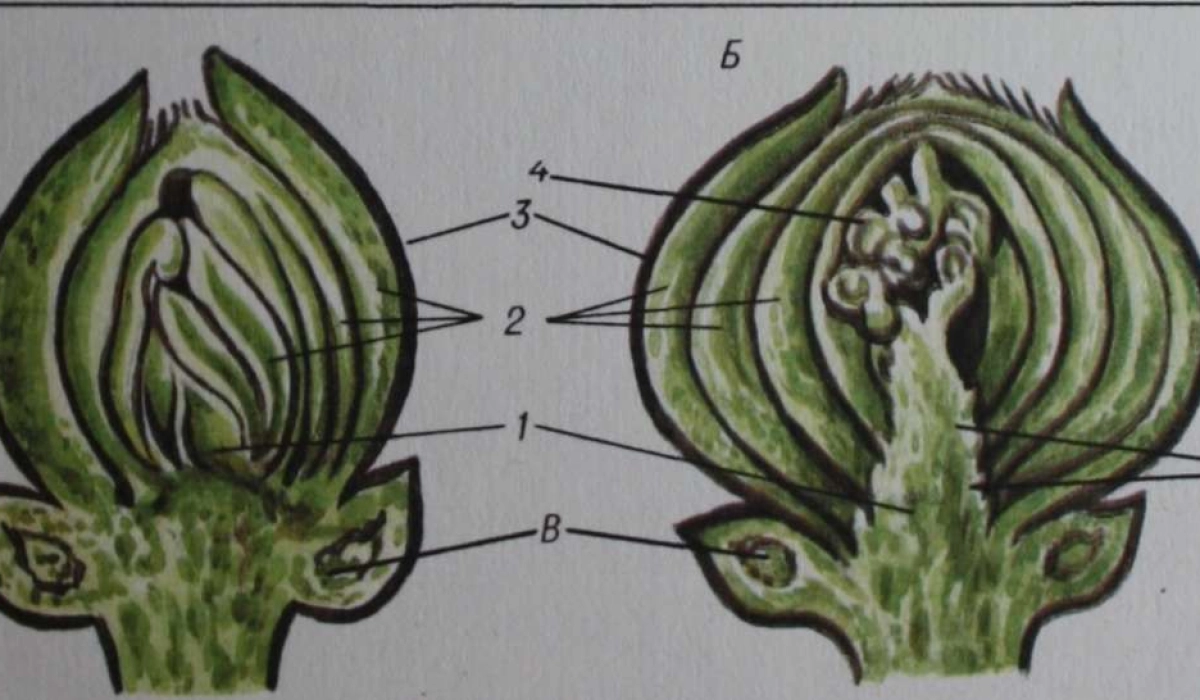
Fig. 11. Anatomical structure of vegetative (A) and vegetative-generative (B) buds: 1 — axis; 2 — leaf buds; 3 — protective scales; 4 — flower buds; 5 — axillary bud buds; B — additional buds.


Fig. 13… New growths developed from buds: a — vegetative; b — vegetative-generative; c — generative.
Fig. 12. Buds: 1 — vegetative; 2 — generative.
Buds that do not grow in the next year after formation are called dormant. They can retain the ability to sprout for many years. Due to the fact that as the branch thickens, its axis elongates and remains close to the bark surface, such buds can initiate shoot growth at any age of the tree if needed. Dormant buds include reserve buds.
Depending on their position on the branch (shoot), buds are classified as terminal (apical, terminal) and lateral (collateral). The latter are further divided for convenience of identification into inner and outer. Inner

Fig. 14. Dormant buds at the base of branches: a — one-year-old; b — three-year-old; c — multi-year-old.
Fig. 15. Awakening of dormant buds after frost damage.
Fig. 16. Elongation of the axis of a dormant bud as the branch thickens.

Fig. 17a


Fig. 18. Buds: 1 — terminal; 2 — outer lateral; 3 — inner lateral; 4 — single; 5 — clustered (flowering buds ready to open).

Fig. 17. Shoots from dormant buds on branches: a — main; b — drooping.

are located on the side of the branch facing the central crown axis, while outer buds are on the side facing the crown periphery.
Based on the time of sprouting, buds are divided into early-sprouting buds, which sprout in the year of formation, and late-sprouting buds, which sprout at the beginning of the next vegetative period. Early-sprouting buds are usually found in stone fruits. In stone fruits under conditions of the middle belt, this phenomenon is rare, and when it occurs, it is referred to as secondary growth, or the second wave of growth.
Depending on the type of bud from which the shoot originated, its position on the branch, and its functional characteristics, the following shoots are distinguished.
Normal, or spring, shoots — all shoots normally developing at the beginning of each vegetative season from terminal and lateral buds of one-year-old branches. Among them, shoots of continuation, or elongation, of the central leader, main branches, and subsequent order branches, formed by the sprouting of terminal buds, as well as lateral (inner or outer relative to the tree's central axis) shoots, developing from corresponding lateral buds. Shoots formed from one or two buds closest to the terminal are called competitors. They are usual-
Fig. 20. Branches: 1 — vegetative; 2 — generative; 3 — continuation; 4 — competitor; 5 — outer lateral; 6 — inner lateral.
